
It’s the summer of
You-W here at CSN, as we head towards our
CSN Celebration on August 4
th and celebrate 10 years of Leadership Learning. What can you do to improve yourself? Heather Maietta has some suggestions below. We’re also focusing on you by improving your communication style, checking in on your leadership skills, and telling a joke or two in the office.
Here’s to
You-W!
 :: Image of the Week
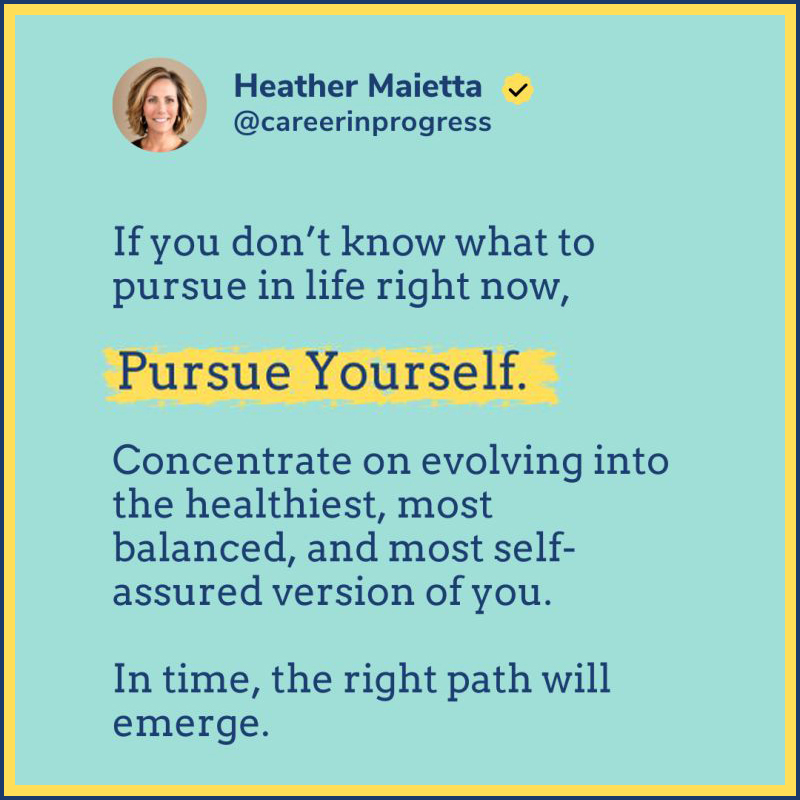
If you don’t know what to pursue in life, pursue yourself
As a career coach, I often hear clients say they’re unsure of what to pursue next. The uncertainty can feel overwhelming. But here’s something I always remind them:
If you don’t know what to pursue in life right now, Pursue yourself. Career clarity doesn’t always come from searching for the “perfect job.” It comes from building a strong foundation of self-awareness, confidence, and well-being. The right path will emerge when you’re ready for it. Trust the process.
From
Dr. Heather Maietta on LinkedIn
“Give yourself first… and treat yourself well. What you don’t give yourself, you cannot give to others in a meaningful way.” – unknown author
:: Communication
Create Space Between Stimulus and Response
From
Susan David’s weekly newsletter on Emotional Agility:
We all make the mistake of confusing our feelings for facts from time to time.
Maybe you feel that a colleague is undermining you in a meeting, so you tell yourself that they don’t respect you. Your anger rises and you lash out. Or maybe your partner brings up the family finances—something that often leads to an argument. Your anxiety spikes, so you quickly change the subject then proceed to shut down for the rest of the evening. While our emotions can be valuable data, it can be unproductive to treat them as directives we must follow.
Viktor Frankl, a psychiatrist who survived a Nazi death camp and went on to write
Man’s Search for Meaning, shared this sentiment:
Between stimulus and response there is a space. In that space is our power to choose our response. In our response lies our growth and our freedom.
Being emotionally agile requires us to seize that space between stimulus and response.
Think about the times when you feel most anxious and afraid. Which subjects trigger your fight or flight response? What leaves you with a lump in your throat or a pit in your stomach?
Now consider how you respond to these tough emotions. Do you try to push them out of your mind? Do you feed your anger with frustration?
Next time you encounter this trigger, rather than reacting mindlessly, try the following steps to create space:
- Pause
- Take a deep breath
- Consider what would actually allay your concerns, or at least allow you to face them
- Ask yourself: Who do I want to be in this moment?
- Ask yourself: What is the next brave step?
In the hypothetical situations above, this could mean an honest conversation with your colleague or a meeting with a financial planner. It could also mean that your body is asking you to simply slow down and allow yourself to feel the way you feel before taking any action at all.
When we create space between stimulus and response, we can reclaim our freedom to move forward in a way that is congruent with our values.
Transparency + Decision Making in Crisis
A recent article from The Adaway Group on promoting transparency, especially in challenging times. So many organizations struggle with transparency already… and what happens during a crisis? Transparency decreases –folks are trying to move quickly, folks are activated and not thinking clearly. Transparency requires thoughtfulness. Transparency is a practice, the more you do it the more habitual it will become.
https://mailchi.mp/adawaygroup/transparency-decision-making-in-crisis?e=11aa67c008
:: Mental Health and Self-Care
The Surprising Science of Joy: What Research Got Wrong
You know those moments when science confirms what ancient
wisdom has been telling us all along? I love it when it happens! Today, I want to share some fascinating discoveries about joy that completely transformed my understanding of
happiness—and I believe they’ll surprise you too.
https://www.psychologytoday.com/us/blog/mindfulness-for-wellbeing/202505/the-surprising-science-of-joy-what-research-got-wrong
“In quietness are all things answered.” – Helen Schucman
:: Recognition
Celebrating Outstanding IT Professionals
UW–Madison recognized outstanding IT professionals at the annual
IT Recognition Awards on May 29, celebrating innovation, community building and transformational work across the university. These awards spotlight the people behind the IT systems who make UW–Madison’s teaching, research and operations possible – from cybersecurity champions to lifelong mentors.
Check out the full list of recipients here:
https://it.wisc.edu/news/meet-the-2025-it-recognition-awards-winners/
:: Self-Leadership Development
Five Characteristics of Leaders
Here are five characteristics of leaders, per Rishad Tobaccowala, author of Rethinking Work.
- a) Capability: To be a leader you have to be capable in your field of work or craft. You have to know your shit. You have to keep improving your skill. Doctors will not listen doctors who are not great at medicine. A creative will not respect someone whose body of work they do not admire.
- b) Integrity: Can one be trusted? Are we transparent about the ingredients of our decision making. Does one look for opposing evidence and use real facts ?
- c) Empathy: Leaders can see from other points of view and they understand that employees are people and work is but a sliver of their being. They understand and they listen. They care. They do this both for employees and for customers.
- d) Vulnerability: Great leaders acknowledge mistakes. They know they do not have all the answers. This means they are open to criticism and correction and they surround themselves with skill sets that offset and balance their areas of weakness.
- e) Inspiration: How do leaders face and acknowledge reality and hard truth but still get people to unite, align and take the challenges head on? They do so by recognizing that people choose with their hearts and not their minds. They inspire through a combination of personal example and storytelling.
From Rishad’s weekly newsletter “The Future Does Not Fit in the Containers of the Past – Edition 243.”
https://rishad.substack.com/p/4-keys-to-leading-today
:: Active Listening
What Comedians Can Teach Us About Thriving at Work
Comedy isn’t just about laughs—it’s about deliberate connection. Sound like a workplace you want?
Comedians are trained observers. They tune in to emotion, behavior, and patterns. It’s their job – and it’s also their superpower in relationships. Which makes you wonder: If those skills help comedians thrive at home… shouldn’t we be using them more at work?
That’s what writer Henna Pryor digs into in this quick read!
https://www.inc.com/henna-pryor/what-comedians-can-teach-about-how-to-thrive-at-work/91190035
“When you laugh, you change and when you change, the world around you changes.” – Dr. Madan Kataria
:: CSN’s Book of the Week Recommendation
Do Nothing: How to Break Away from Overworking, Overdoing, and Underliving
We work feverishly to make ourselves happy. So why are we so miserable?
Despite our constant search for new ways to optimize our bodies and minds for peak performance, human beings are working more instead of less, living harder not smarter, and becoming more lonely and anxious. We strive for the absolute best in every aspect of our lives, ignoring what we do well naturally and reaching for a bar that keeps rising higher and higher. Why do we measure our time in terms of efficiency instead of meaning? Why can’t we just take a break?
In Do Nothing, award-winning journalist Celeste Headlee illuminates a new path ahead, seeking to institute a global shift in our thinking so we can stop sabotaging our well-being, put work aside, and start living instead of doing. As it turns out, we’re searching for external solutions to an internal problem. We won’t find what we’re searching for in punishing diets, productivity apps, or the latest self-improvement schemes. Yet all is not lost—we just need to learn how to take time for ourselves, without agenda or profit, and redefine what is truly worthwhile.
Pulling together threads from history, neuroscience, social science, and even paleontology, Headlee examines long-held assumptions about time use, idleness, hard work, and even our ultimate goals. Her research reveals that the habits we cling to are doing us harm; they developed recently in human history, which means they are habits that can, and must, be broken. It’s time to reverse the trend that’s making us all sadder, sicker, and less productive, and return to a way of life that allows us to thrive.
https://a.co/d/2CAESt8
:: Work Culture & Team Development
You Culture Doesn’t Need a Hero. It Needs a Tag Team.
Let’s be real—leaders are tired.
Not because they don’t care, or aren’t committed, or aren’t “resilient enough.” They’re tired because they’re carrying the weight of culture on their own. We ask leaders to role model the values, coach their teams, drive change, deliver performance, communicate clearly, stay human, hold accountability, and somehow still make it to their kid’s soccer game. That’s not leadership—that’s survival mode with a PowerPoint deck.
And it’s not working.
Culture doesn’t thrive when it’s one more thing on a leader’s plate. It thrives when leaders are part of something bigger. A system. A support structure. A tag team.
https://www.cultureconusa.org/post/shared-leadership-culture
“I find the projects I’m most excited to work on are nearly always the projects that have really fantastic people associated with them.” – James Clear
How to Find Solutions When There Are No Good Options
You’re facing a problem with no obvious solution.
Maybe it’s a work challenge, a family issue, or a personal dilemma. You’ve thought about it from every angle, but every option seems flawed. You’re stuck, frustrated, and running out of ideas.
Today, Jason Feifer shows you a simple but powerful technique that can break you out of this trap. He calls it List Before You Leap.
The idea is this: Before deciding what to do, list every solution you can think of — even (and especially!) the really bad ones. This may sound simple, but doing it will feel profound. It will help you find solutions you never would have considered otherwise.
https://www.jasonfeifer.com/how-to-find-solutions-when-there-are-no-good-options/
Six steps to accomplish a goal
A few years ago, Steve Klubertanz went on a much-needed vacation from the cold and crappy Midwest winter; a kayaking trip on a Florida river.
Soon into the journey he realized the techniques of kayaking can be metaphorically applied to almost any project, life, or career ambition we set for ourselves.
Before reading further, think about a particular goal you really want to accomplish. Now, try to connect the symbolism and apply a similar strategy to reach that goal.
https://www.linkedin.com/pulse/six-steps-accomplish-goal-steve-klubertanz-nulpc/
:: Communities of Practice
Neurodivergent CoP Planning Meeting
Audrey Mickelson is sending an invitation for an initial gathering to talk about the possibility of a neurodivergent-centered Community of Practice (CoP). Their introductory meeting will take place on June 23, from 11:00-12:15 online. If you have interest in this type of community, please reach out to her directly at
abmickelson@wisc.edu to get more details.
Date: June 23, 2025
Time: 11:00am-12:15pm
Location: online (contact Audrey for the link)
:: Upcoming Events
Exploring the Landscape of Hope in Servant Leadership
In many circles, hope has gotten a bad rap as having no connection to reality. In the June meeting of the Servant Leadership Group at UW–Madison, we will explore the often-hidden dimensions of hope, using essays from Leif Hass, an emergency room physician, and Rebecca Solnit, who wrote “Hope in the Dark.” “Hope is not the belief that everything was, is, or will be fine,” she writes. “Hope locates itself in the premise that we don’t know what will happen and that in the spaciousness of uncertainty is room to act.”
“Hope, like other emotions, can be contagious,” Hass writes. “Together, people can support, motivate, brainstorm, and strategize. … (we are) committing to ‘facing this together.’”
Together, we will explore how to define hope, what it is, and is not. We will look at the landscape of hope, rooted in uncertainty, and how to cultivate hope and build hope together. How do servant leadership practices align with hope? Join us as we examine the intersections of these powerful ways of being.
June 20, 2025
8:30-10:00 am CST
Online via Zoom:
go.wisc.edu/ad5684
Meeting ID: 987 0673 4791
Passcode: 156691
Man Enough to Feel: Mental Health, Empathy, and Breaking Barriers with Trevor Noah
Date: June 24, 2025
Time: 1:00-2:00 PM CST
Location: Online via weblink
Join Lyra Health for a special rebroadcast of a powerful conversation from Breakthrough, their annual mental health conference. In this thought-provoking fireside chat, Trevor Noah, comedian, bestselling author, and former host of The Daily Show, shares his personal journey with ADHD and depression with Chris Jackson. He explores how he turned challenges into strengths, using empathy and humor to make mental health topics more approachable and relatable.
You’ll gain insights on reducing stigma, supporting men’s mental health, and fostering more open conversations in and beyond the workplace. This session invites you to rethink mental health narratives and celebrate the diverse ways we think, feel, and thrive.
Register here:
https://get.lyrahealth.com/webinar-trevor-noah.html
Announcing CSN’s Summer Book Club: The Art of Self-Leadership
Learn to take control of your own professional destiny and lead yourself through challenging situations
In
The Art of Self-Leadership: Discover the Power Within You and Learn to Lead Yourself, celebrated workplace culture and employee engagement expert Heather R. Younger delivers an exciting and practical discussion of how to develop an entirely new mindset around personal advocacy and self-leadership. CSN has featured two other books from Heather in our book club series, and share content from her frequently in the newsletters.
You’ll learn how to take control of the workplace experience and set expectations up front about relationships.
What’s Inside:
- Chapter 1: Understanding Your Intrinsic Worth
- Chapter 2: Understanding your Limitations
- Chapter 3: Is Fear Holding You Back?
- Chapter 4: Deciding Between Progress and Perfection
- Chapter 5: Prioritizing Self-Care
- Chapter 6: The 3 Stages of Empowerment
- Chapter 7: Keying in on Your Strengths
- Chapter 8: Building Bridges not Digging a Divide
- Chapter 9: More Than One Way to Skin a Cat
- Chapter 10: Expect Clear Expectations
- Chapter 11: Giving and Receiving Feedback is a Gift
- Chapter 12: Use Your Voice and Be Seen
CSN will meet on Zoom for three sessions to cover the topics in this new release for Heather. Please only register if you expect to attend all three dates: July 17, July 31, and August 14 from 2:30-4:00 pm. Physical books and assignments will be sent out in late June, after registrations come in. Contact Rich Gassen with any questions regarding our book clubs.
Dates: 7/17, 7/31, 8/14
Time: 2:30-4:00 pm
Location: Online via Zoom
(Link will be shared with registrants before event)
Registration link:
https://go.wisc.edu/429lsd
Hurry – these sessions fill up fast!