Planners’ Picks — May 19, 2026

We’re looking at better apologies, better responses to threats, and doing less to do better in our resources this week. Better check them all out! We’ll also let go of what’s out of our control and focus on the things we truly have influence over. Cheers!
:: Image of the Week
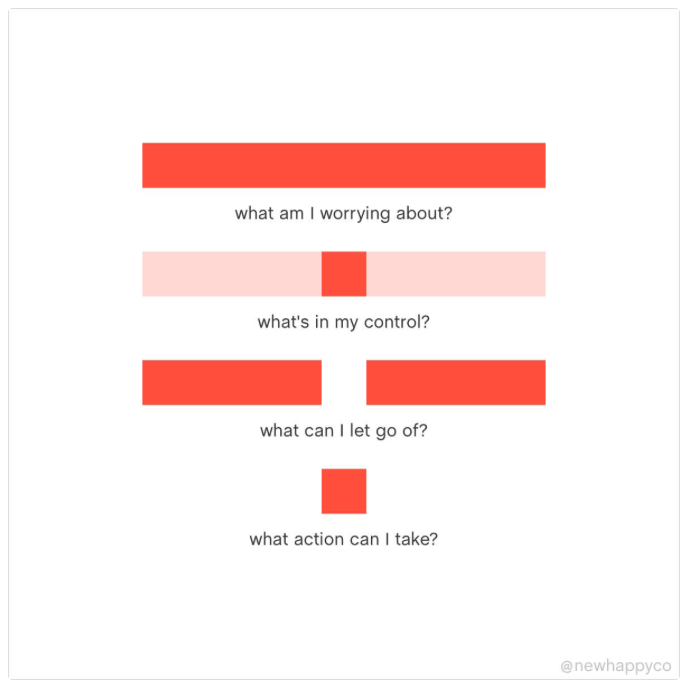
Feeling stressed? Try this:
Step 1: List out everything you’re worrying about. Get it out of your head and onto paper.
Step 2: Look at your list and put a star next to anything that’s within your control. Where do you have some power or agency?
Step 3: Look at everything that doesn’t have a star next to it. Consciously decide you’re going to put those worries down for a little while. If it helps, choose when you will revisit them.
Step 4: Go back to anything you starred and choose only one of them to focus on. Now, take just one small step that addresses the worry.
Over time, this practice helps us learn how to tease out different elements of control and impact, build our agency and resilience, and practice acceptance for what is outside of our control.
Image and text from the daily newsletter https://www.thenewhappy.com/blog/in-my-control
:: Communication
The Emotionally Intelligent Apology
I don’t know who needs to hear this… but “I’m sorry you feel that way” isn’t an apology.
… It’s actually an insult.
Why? Because it minimizes someone’s feelings while subtly shifting the blame onto them for having the feelings in the first place. A more emotionally intelligent response sounds like:
“I’m sorry. That was not my intention.”
See more on better apologies from Tara Renze: https://www.linkedin.com/pulse/emotionally-intelligent-apology-tara-renze-gn7jc/
“You can take things seriously without taking them personally. Our tendency is to turn any criticism or complaint into a personal attack. We reply to it, defend against it, build a counter-argument, lose sleep over it. You don’t have to eat everything that is served to you. You can respond to criticism without digesting criticism. Take what’s useful, do your best to improve, and leave the rest.” – James Clear
What You’re Listening For (And What You Might Be Missing)
Imagine someone shares a charged, vulnerable story in a meeting and the room goes quiet. In that silence, where does your mind go?
You might reach for warmth and attunement, affirming what you heard and helping the speaker feel less alone. You might feel pulled to “zoom out,” offering a fresh frame or new possibility that helps the group make sense of the story. You might process internally, quietly connecting what was said to your own experience. Or you might scan for the facts, silently checking details for accuracy and wondering how this story translates into a tangible next step.
None of these instincts are wrong, but they represent four very different ways of processing the world. Whether conversations open up or harden often comes down to something we rarely name: what we’re listening for. Noticing your filter can help you adjust in real time, so you can really listen (and be listened to) in return.
This issue of The Greater Good’s newsletter is a must-read for those in positions where listening is important (hint: that’s most of us!)
https://greatergood.berkeley.edu/article/item/what_youre_listening_for_and_what_you_might_be_missing
:: Job Searching & Interviewing
5 Hidden Ways Hiring Managers Test You
You’ve heard about the sneaky ways that hiring managers “test” candidates, such as bringing a job candidate into the coffee-break room to see whether they eventually bring their dirty cup to the sink. Or asking a question in the foreign language the candidate’s résumé claims they’re proficient in. Professional hirers have tricks up their sleeve when it comes to gaining intel on candidates.
The tests are there for a reason: to allow the recruiter to assess everything from cultural alignment to situational awareness. And they’re much more critical today, when candidates can use AI to create a false front. “Small, informal moments can surface behaviors that don’t show up in a structured interview,” says Anya Weaver, a principal consultant at Korn Ferry. For example, a candidate’s lunchtime order can reveal everything from a mindfulness about spending corporate money to a problem with alcohol.
So, what are recruiters looking for?
:: CSN’s Book of the Week Recommendation
Born to Flourish: How New Science and Ancient Wisdom Reveal a Simple Path to Thriving
How can we live happy, fulfilling lives in the face of today’s challenges? This accessible program grounded in neuroscience answers the question with simple practices we can easily fold into our daily lives for profound results. Written by UW–Madison’s own Dr. Richie Davidson, PhD, and Dr. Cortland Dahl, PhD.
In a world pulling our thoughts and emotions in so many directions, Born to Flourish offers a way to turn stress and anxiety into clarity and calm. Renowned neuroscientists and contemplative teachers Richard J. Davidson and Cortland Dahl bring us a powerful program rooted in decades of research from the Center for Healthy Minds and the non-profit Humin. Focusing on four transformative practices, they bring us key tools to help train our brains to overcome depression, despair, and loneliness.
· Awareness: Learn to be fully present with your emotions so that you can embrace all of life’s ups and downs.
· Connection: Grow meaningful relationships and a sense of belonging by cultivating kindness and appreciation.
· Insight: Learn to know yourself through self-inquiry, so that you can break free from old narratives.
· Purpose: Connect with your core values and guiding motivation to create clarity and make sound decisions.
We are all born with a natural ability to flourish, but that ability needs to be trained for us to live a thriving life. The good news is that only a few minutes of practice each day makes a measurable difference. With actionable steps and inspiring stories, Born to Flourish helps you integrate these practices effortlessly—whether you’re commuting, doing chores, or simply lying in bed.
This is a call to embrace life’s chaos and tap your inner strength. For anyone seeking to enhance their mental health and overall well-being, Born to Flourish will light a way forward.
https://www.humin.org/wellbeing-tools/books/born-to-flourish
“If all you did was look for things to appreciate, you would live a joyously spectacular life.” – Esther Hicks
:: Self-Leadership Development
Leadership is About Optimism and Learning
CSN happened across a LinkedIn post recently by United Airlines CEO Scott Kirby about some of his recent favorite books. We didn’t think much of it until I later found an interview he did with McKinsey.
In this 12-minute interview, he talks about the distinction between leadership and management, how optimism is so critical for leaders, and why he spends hours reading each day.
https://www.mckinsey.com/Videos/video?vid=6390705223112&plyrid=IzQolWCsY
Fear is Not the Stop Sign
What happens when life forces you to confront the stories you’ve been telling yourself about timing, readiness, and control? Amy and Ashley explore the powerful question many leaders quietly wrestle with… what are you waiting for?
Through raw personal reflection and compassionate conversation, Ashley shares her experience navigating unexpected health challenges, loss of choice, and the realization that fear often disguises itself as logic. Together, Amy and Ashley unpack how waiting for the “perfect moment” can keep us stuck, and why courage is less about eliminating fear and more about moving forward with it.
This episode is an invitation to pause, reflect, and take one intentional step toward the life you want to live. If you’ve been postponing your health, your dreams, or your next bold move, this conversation will challenge you to stop living in theory and start living in proof.
https://www.youtube.com/watch?v=AQZlDBD5ggg
“Fear has its use but cowardice has none.”– GANDHI
Triggered at Work: How to Keep Your Influence When Emotions Run High
We watched it happen like a car wreck in slow motion. Two executives (one’s the boss). A long history. A room full of peers. And that unmistakable energy in the air that says, Oh no. Here we go. They’ve known each other for years—the kind of relationship where you don’t just know someone’s strengths. You know their sensitivities. Their hot buttons. The exact words that will light the fuse.
And in front of several colleagues—people who matter—the boss says the triggering words. The phrase is almost casual, tossed out like it’s no big deal. But it isn’t casual. It’s calibrated. It lands exactly where the boss knows it will land. The recipient of the triggering words (let’s call her Jane) pauses for half a second. Jane’s eyes change. Her shoulders tighten. Her face shifts. And then she loses it.
When Someone Pushes Your Button, Don’t Hand Them the Remote
Read below for some practical tips to manage your emotional responses when you’re triggered at work.
:: Work Culture & Team Development
Tapping into Your Team’s Circadian Rhythms
Although corporate culture has favored “morningness,” effective bosses recognize that people have different, hard-to-change circadian rhythms causing daily fluctuations in peak functioning. They must manage themselves and assign tasksaccordingly. Strategic thinking, feedback, and emotionally demanding activities work best during high-energy periods. During low-energy periods leaders should delegate and adopt lower-intensity roles. For teams, schedule high-stakes collaboration during shared peaks and assign challenging tasks during individuals’ peaks and routine work during off-peaks. When peak alignment isn’t possible, prioritize recovery, flexibility, and rotation to prevent burnout and sustain performance.
:: Trust, Psychological Safety & Belonging
Not fight, flight or freeze, but fawn
Most of us are familiar with the ‘fight, flight or freeze’ responses, the nervous system’s ways of responding to a perceived threat. The fawn response, conversely, is when you move toward the source of discomfort by trying to appease it, rather than withdrawing or resisting. The psychotherapist Pete Walker, who popularised the term, describes it as a strategy of becoming more appealing to the threat as a means of self-protection.
“Patience and perseverance have a magical effect before which difficulties disappear and obstacles vanish.” — John Quincy Adams
Respect confidentiality to build a culture of trust and dignity.
Have you ever been in a meeting or a performance conversation when someone asked, “But what about them?” Or you’re leading a team meeting, and someone asks for other confidential information: “Why did they choose her to get that promotion?” or “What’s happening with the merger—am I going to lose my job?” Suddenly, you feel put on the spot. You want to respect confidentiality, but you also want to be honest with your team.
As a leader, people bring you information they wouldn’t share anywhere else—concerns about teammates, personal struggles, frustrations about fairness, or mistakes they’re trying to fix. In those moments, your response does more than solve a problem.
It tells your team whether their conversations with you are truly safe. And if your employees can’t trust you to respect confidentiality, their problems don’t disappear—they simply go underground, where they grow bigger and harder to solve.
Respecting confidentiality is not just about keeping secrets. It’s about creating a climate where people feel safe telling the truth. When employees believe you will handle sensitive information with care, they are far more willing to raise problems early, share perspectives, and work through conflict productively.
:: Productivity and Innovation
Do Fewer Things. Do Them Better.
Dieter Rams, the legendary designer at Braun, worked from a simple belief: almost everything is noise. Very few things are essential.
His job was to filter through that noise until he reached the essence.
Early in his career, he was asked to help design a record player. At the time, the norm was to encase it in a heavy wooden lid or build it into a piece of living room furniture.
Instead, Rams and his team removed the clutter. They designed a player with a clear plastic cover and nothing more.
It was so different that people worried it might bankrupt the company.
But it didn’t.
Over time, it became the standard that every other record player followed.
Rams’ philosophy can be captured in three words: Weniger aber besser.
Less but better.
Read the entire newsletter from Greg McKeown on less but better here: https://mailchi.mp/gregmckeown/1mw04082026?mc_cid=a88d053982&mc_eid=64ed34cb6e
Motivation is what gets you started. Habit is what keeps you going. – Jim Ryun
:: Upcoming Events
CSN’s Summer Book Club: The Octopus Organization
Three sessions. Three big ideas. One smarter way to lead.
This summer, the Campus Supervisors Network is exploring The Octopus Organization, a book that reimagines how teams create clarity, build ownership, and strengthen accountability in a rapidly changing workplace.
We’ll break the book into three one‑hour sessions, each focused on one of its three core parts and 36 antipatterns:
- PART 1 — Creating Clarity (June 16: 1:00-2:00 pm)
- PART 2 — Increasing Ownership (July 9: 1:00-2:00 pm)
- PART 3 — Inciting Curiosity (July 23: 1:00-2:00 pm)
Join one, two, or all three sessions — whatever fits your summer schedule. Participants will receive instructions for accessing the book through the UW–Madison Libraries, so no purchase is required.
This is a great chance to connect with colleagues and sharpen your leadership practice in a low‑pressure, high‑impact format.
Registration opens later this week, so keep an eye on your inbox and the CSN website!
Free professional development courses offered by LTD
Work at UW–Madison rarely stands still. Across campus, employees are navigating ongoing change while continuing to advance teaching, research, and service. When challenges arise, the ability to adapt, stay focused, and support one another helps ensure work moves forward. Employees who build resilience are better equipped to navigate change, make more informed decisions, and help professional relationships thrive. Anyone aiming to approach change with more confidence will find that building resilience provides a solid starting point and offers a strong foundation.
Registration is now open for free professional development courses offered by Learning and Talent Development to help you become more resilient, understand and lead change, learn how to solve problems that cause stress, and challenge yourself to think in a new way.
- Personal Resilience and Accountability – Free course with practical, research-based strategies to help you build resilience, take action, and support yourself and others during stressful times.
- Understanding and Leading Change – Free course that gives you tools to better understand change components, change styles, and transition management, to help proactively lead and support others.
- Managing Stress and Finding Vitality at Work – Free course that helps you manage stress by reframing your thinking, solving root causes, and building healthier responses.
- Enhance Your Supervision and Management – Free, interactive learning series, available exclusively to UW–Madison people managers, focused on strengthening leadership, improving team performance, and sharing best practices with peers.
New Career Development Course Launch
A new course, It’s Your Career: Having a Productive Career Development Conversation with Your Supervisor is now available to all UW–Madison employees. We want to let you know about this resource for you and the employees you supervise.
This 30-minute, self-paced course is designed to help employees reflect on their strengths, interests, values, and development goals. It guides them in creating a simple career development plan and prepares them to initiate a thoughtful conversation with their supervisor, mentor, or another trusted person. As a result, you may begin to see more employees reaching out to schedule career-focused discussions.
Research consistently shows that regular career development conversations increase engagement, motivation, and retention. Employees who feel supported in their growth are more likely to bring energy, clarity, and commitment to their roles. This course helps employees become better prepared with clearer goals, thoughtful questions, and a shared understanding that career development includes both success in their current role and preparation for future opportunities.
As a supervisor, your impact comes from listening, asking good questions, and helping employees explore learning opportunities, stretch assignments, and next steps that align with organizational needs.
We encourage you to:
· Support and promote participation in the course.
· Welcome requests for career conversations.
· Approach these discussions with curiosity and openness.
Your engagement signals that career development is valued and that it makes a meaningful difference. View the course at It’s Your Career: Having Productive Career Development Conversations with Your Supervisor.