Planners’ Picks — September 15, 2026

This week we’re leading an improv group on campus and looking at the power of simple ideas. We’re balancing work and life and looking at a new recruitment toolkit. Finally, we’re getting out of the way so we can be our best selves! Enjoy this installment of PP.
:: Image of the Week
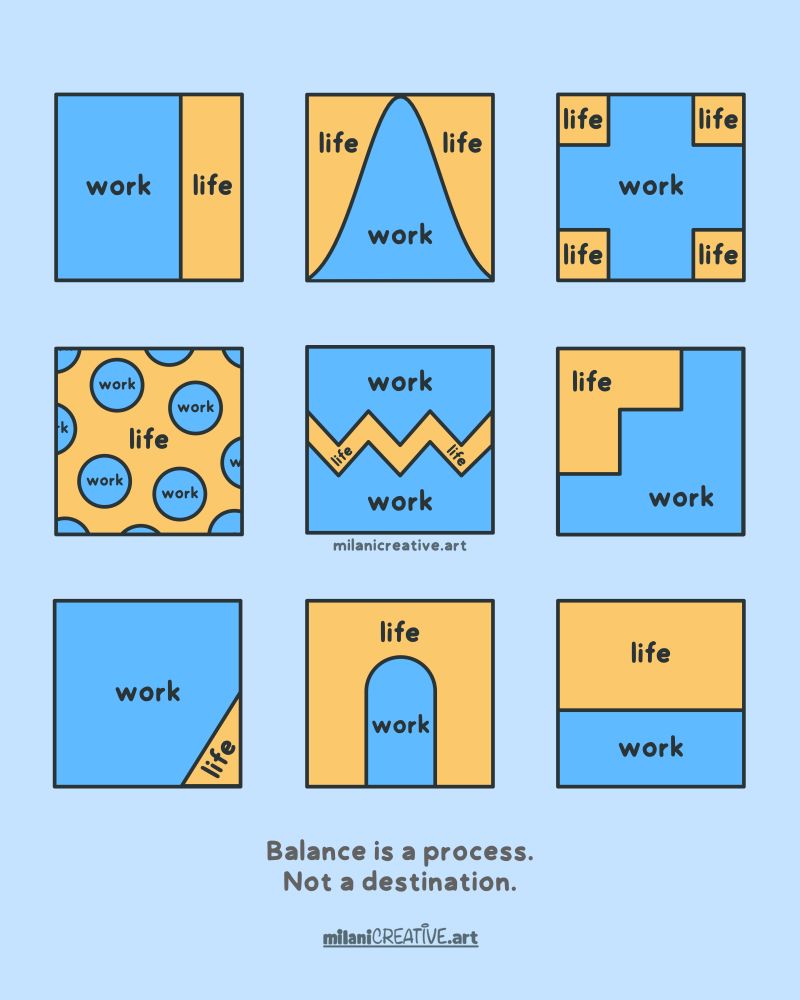
Friendly reminder for the day:
“Balance is a process, not a destination.” – Aunt May, “Spider-Man 2”
There is no one-size-fits-all formula for work-life balance. It’s personal to you AND a moving target based on the stage of your life.
Found on LinkedIn @ Pejman Milani (milanicreative).
:: Trust, Psychological Safety & Belonging
Prevent emotional contagion on your team
There was a time when emotional outbursts at work were rare, but research shows that people are having more frequent emotional episodes, with one in four experiencing strong anger, sadness or frustration on any given workday. Unfortunately, studies show that our ability to cope with others’ emotions is declining. The result is that we’re trying to dig out from a bigger avalanche with a smaller shovel.
What’s behind this trend? The sources of growing emotional dysregulation are diverse. There’s the impact of the news and social media algorithms rewarding increasingly inflammatory content, the dread associated with existential threats posed by climate change or AI and the stress of parenting the most socially anxious generation of children ever. All that, plus the standard performance pressure in any organization.
To make matters worse, emotions aren’t neatly contained within one individual. Teams are susceptible to emotional contagion, in which one person’s emotions unconsciously spread to others, even in virtual meetings. That means one person’s bad morning is one team meeting away from spreading doom and gloom across the whole group.
:: Communication
If Nobody’s Pissed Off, Try Harder
Recently, we lost the great journalist, activist, and second-wave feminist leader Gloria Steinem. Steinem wasn’t the first person with ideas of equality, but she will be remembered for making them mainstream (if you can believe it, they were seen as quite fringe at the time). They went beyond commonly held ideas and metamorphosed into ideas one was expected to hold in culturally elite circles.
Leaders love talking about transformation. New strategies. New campaigns. New goals. Until people push back. Read this tribute to Gloria’s determination to push through the pushback.
https://www.gapingvoid.com/if-nobodys-pissed-off-try-harder
“If you see someone without a smile, give ‘em yours.” -Dolly Parton
The power of simple ideas
The most powerful ideas are often the simplest.
They don’t require a manual. They don’t need a two-hour presentation. People understand them, remember them, and use them.
In contrast, many good ideas never gain traction because they are too complicated. The best leaders keep stripping away what is unnecessary until they reach the core of the idea.
Paul Thornton tells us in simple terms why less is commonly more.
:: Job Searching & Interviewing
Recruitment Toolkit Now Available for Managers and Supervisors
A newly updated Recruitment Toolkit for managers and supervisors is now available, offering clear guidance, practical tools, and campus-aligned best practices for every stage of hiring. The guide is organized into four sections: Recruitment Planning, Recruitment Strategy Development and Outreach, Screening and Interviewing, and Selection and Offer. Each section includes a breakdown of how to successfully navigate each phase with specific tools and links to reference. Templates and outreach tools will help enhance your recruitment strategy. Managers and supervisors are encouraged to work with their local HR for support and to align with campus policies.
Whether you are an experienced or new hiring manager or supervisor, this toolkit is an important reference document to successfully navigate the recruitment and hiring of Faculty, Academic Staff, Limited Appointees, and University Staff employees.
https://hr.wisc.edu/managers-and-supervisors/recruitment/
:: Productivity and Innovation
Five Ways to Pace Yourself to Achieve Ambitious Goals
Hustle culture is back for good, if you take some overachievers’ word for it. The temporary pandemic slowdown, with its emphasis on well-being and flexible scheduling, seems like a fleeting mirage. These days, many startup workers are expected to pull “9-9-6” shifts (9 a.m. to 9 p.m., 6 days a week), and managers brag about subsisting on four hours of sleep.
With sleep-under-your-desk culture now ascendant, more of us feel compelled to keep pace with people who move at one speed: full throttle. It doesn’t help that we have few role models who are good at incremental retreat. “We don’t learn how to pace ourselves,” one workplace consultant told me. “There’s not a class on that.”
But as elite athletes and endurance experts know, going 110% without respite often sets up a crash that takes months or even years to overcome. It’s far healthier—and smarter in the long run—to manage your energy more deliberately, noticing when you’ve neared the edge of burnout and decelerating before you fall in.
Elizabeth Svoboda’s book The Art of Pacing explores how to pull back thoughtfully and incrementally at work, online, in community service, and more. Pacing yourself in this way doesn’t mean disengaging from what you care about—in fact, just the opposite. By setting a more sustainable rhythm, you can keep making fulfilling contributions to your community and the planet for a lifetime. Here are some everyday pacing strategies to help you do that.
https://greatergood.berkeley.edu/article/item/five_ways_to_pace_yourself_to_achieve_ambitious_goals
:: Mental Health and Self Care
Slow down, it’s what your brain has been begging for
Our permanent obsession with speed, as Milan Kundera noted in the novel Slowness (1995), ‘is the form of ecstasy the technical revolution has bestowed on man’. Each piece of technology seductively blinks, beeps and chimes, begging for our attention. In her Master’s thesis while at Stanford University, Devangi Vivrekar catalogued several forms of persuasive design used by sites such as Facebook and LinkedIn. Here are some you may be familiar with, and why they are effective:
- Intermittent notifications: varied delivery schedule is interesting.
- Red colour of notification badge: indicates urgency, arouses curiosity.
- Number of notifications on badges: want to get number to 0, arouses base desire for order out of chaos.
In the same way that a dog is rewarded with a treat, when we succumb to a notification, waves of dopamine surge through our brains, giving us a sense of pleasure. Over time, this addictive pattern erodes the natural cognitive coastline, making us slaves to our devices.
It’s no small task to live a life of sustained attention. So slow down, and give your brain a break to do its work.
Read more on this at https://psyche.co/ideas/slow-down-its-what-your-brain-has-been-begging-for
Resources from Dr. Amit Sood for Mental Health
Dr. Amit Sood is a specialist in meditation, resilience, and self-care strategies in children and adults. His robust website has many resources available to view, download, or add as an app to your phone. Check out this link to the Adult section of his resources, including meditation videos, expert videos, engaging reads, and more.
https://www.amitsood.com/adults
:: Self-Leadership Development
Make Plans Now to Join the Supervision and Mastermind Exchange
There is one more chance to join a committed group of colleagues for peer-supported learning before the year ends.
Managing and supervising are such important jobs, and it can be lonely sometimes. The Supervision and Management Mastermind Exchange is an opportunity to build a space to discuss real situations in a structured way.
You can expect a peer-supported collaborative environment that will be highly interactive, including small group activities and discussions. Participants will share challenges and work together to problem-solve, share perspectives, brainstorm, innovate, and network. This is a committed group for a short time.
December 2026–February 2027
Sessions: Five total, held every other Wednesday
Dates: December 2, December 16, January 6, January 20, February 3
Time: 2:30–3:30 p.m.
Location: Zoom (virtual)
https://docs.google.com/forms/d/e/1FAIpQLScYowN9ngg0mjCiHhDrahyZKNgGlOuwa-HJij99bKM1sY-M-Q/viewform
Note: To access the interest form, you must be logged in to Google with your campus NetID.
“It is impossible for anyone to begin to learn what he thinks that he already knows.” — Epictetus
When Leadership Gets Out of the Way
What if one of the most important things a leader can do is create the conditions for people to stop depending on the leader?
In this podcast, Handson Coaching host Hedinn was joined by Barry Moline for an Inspiring Conversations session about what happens when leaders stop trying to be at the centre of everything and start creating the conditions for people to connect and work well together.
Barry brings an interesting perspective to that question. After 29 years as a CEO, including leading organisations responsible for essential energy and water services, he thought he understood how to bring people together. Then, while writing his book CONNECT!, he began questioning some of his own assumptions.
https://www.linkedin.com/events/7498688992087920640/
The first 90 days: How to listen before you lead
The average American changes jobs 12 times over their career, according to research from the Bureau of Labor Statistics examining the career trajectories of older Boomers.
If those statistics hold for younger generations in the workforce, that means we will, on average, recalibrate our work and our work relationships every 4 years.
So how do we do that well?
That question was on Daniel’s mind, a mid-career leader who reached out to me a few weeks ago. Daniel is moving his family across Canada to become the lead pastor of a congregation in Ontario.
“I want to start by listening,” Daniel told me. Then he asked for help in finding good questions for uncovering the congregation’s realities — the sort of truths that, without intentional listening, would otherwise take leaders months or even years to understand.
If you’re a new leader at a company, take time to listen to your employees to create understanding and psychological safety, writes Amber Johnson.
“The idea of waiting for something makes it more exciting.” ― Andy Warhol
:: Kindness in Leadership
Kindness makes work easier than it is
Working is hard. All jobs, no matter what they entail, are hard. Even if you think they look easy, I can guarantee you they aren’t.
Today, something simple to remind you about.
Kindness makes work easier than it is.
Unkindness makes it harder. See Karyn’s quick post for the rest of her thoughts.
:: LinkedIn Learning
Active Listening for Better Leadership Communication
Even as new technologies have prompted radical changes in the world of work, basic interpersonal communication skills remain as critical as ever. In this course, join Heather Younger—the two-time best-selling author of The 7 Intuitive Laws of Employee Loyalty and The Art of Caring Leadership—as she details what active listening is, why it’s a critical skill for leaders, and how to optimize communication so your employees feel heard, valued, and understood. Heather shares her five-step framework for active listening and explains how to discern passive listening from active listening, detect and respond to common nonverbal cues, and demonstrate curiosity and empathy when actively listening. She also shares specific tactics to help you become more present, expand your decision-making circle, and properly communicate the connection between team feedback and the actions you take based on that feedback. Tune in to take the first steps towards becoming a better listener and leader.
“I know of no better life purpose than to perish in attempting the great and impossible.” – Friedrich Nietzsche
:: Take Five
*Note: CSN occasionally adds “Take Five” articles to take you off the beaten path. Articles are about local or regional areas of interest, but not necessarily focused on leadership development. The intent is for you to take a break from being a leader and relax for a moment!
UW–Madison in Four Walks
Join us for a classic stroll around the world’s most beautiful urban campus. Enjoy this photo-rich article from OnWisconsin on the great trails right in our area.
:: Upcoming Events
Stop Waiting for Stability:
Fireside Chat with Whitney Johnson and Dana Ianuzziello
Some organizations come out of disruption stronger. Others just come out exhausted.
Here’s the difference: the ones that thrive keep developing their people in the middle of the mess. These are the ones that don’t press pause, waiting for a calm that never arrives.
The hard part isn’t believing that. Most leaders already do. The hard part is making the case—to your CFO, to your team, to yourself—when the budget is tight, the reorg is landing on an unready team, and “later” feels so reasonable.
That’s what author and speaker Whitney Johnson wants to get into.
On September 16, she’s going live with Dana Ianuzziello at EZRA for a fireside chat called Stop Waiting for Stability. They’ll talk about why waiting is the most expensive strategy there is, what building your leaders looks like mid-reorg, and how to actually make the case for coaching when there’s no room in the budget. You won’t just leave with the why. You’ll leave with the language to walk into that conversation and win it.
If you’re an HR, Talent, or L&D leader navigating change, or a leader who wants coaching and has to make the case for it, this one’s for you. If you’ve got a budget conversation coming this quarter, come get the words for it.
Date: 9/16/26
Time: 11:00 am CST
Register: https://get.helloezra.com/stop-waiting-for-stability/