Planners’ Picks — November 10, 2026

We’re moving into the holiday season quickly — let’s pause before that pandemonium to become someone others want to believe in, map our productivity, and make ourselves known with the help of these resources. Remember, not every thought deserves your attention!
:: Image of the Week
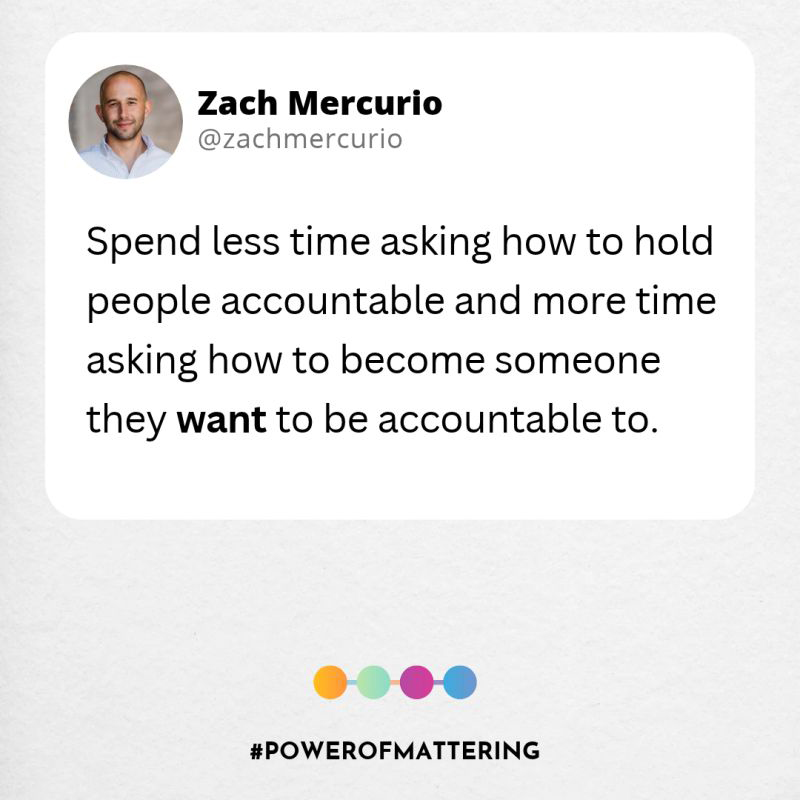
Many leaders spend a lot of time talking about holding people accountable, but not enough time talking about how to be someone people want to be accountable to. People comply with high expectations out of fear in the short term, but they take true ownership in the long term when they’re committed to someone who’s committed to them.
We want to be accountable to people who demonstrate care for us, believe in us, and see and invest in our potential. Personal accountability often comes as a byproduct of interpersonal investment.
From Zach’s LinkedIn post: https://lnkd.in/p/gWjVMZkt
“Ninety percent of success can be boiled down to consistently doing the obvious thing for an uncommonly long period of time without convincing yourself that you’re smarter than you are.” – Shane Parrish
:: Kindness in Leadership
The Transformative Power of Kindness
On this heartfelt episode of Love and Compassion Podcast, Gissele Damiani-Taraba speaks with Cindy Rowe, who teaches individuals and organizations about the power of kindness. They talk about the transformative role kindness has had in her life, helping her deal with trauma and adversity. We also talk about the difference between kindness and “niceness”, why kindness cannot exist without boundaries, and why forgiveness is important at work! This episode is medicine for our soul.
World Kindness Day is November 13 – how can you extend a simple act to someone around you?
https://www.youtube.com/watch?si=r-ZVg_Trf–v4154&v=BXXj0qPyhfI&feature=youtu.be
:: Self-Leadership Development
You do not need more discipline
Most productivity advice is written by morning people. Wake at five. Do the hard thing first. Protect your mornings. Excellent advice, if you happen to be a morning person.
Chronotype is the name for your body’s internal timing. It is substantially heritable, it shifts across your life, and it sets the window where your alertness and your sharpest thinking naturally peak. Some brains crest early. Some crest late. Most sit somewhere in between.
The useful part is not which one you are. It is what you have been scheduling against it. If your analytical peak lands at 10 a.m. and you spend 10 a.m. clearing your inbox, you are not disorganized. You are spending your best hour on your cheapest work. Then you hit the hard thinking at 3 p.m., after your brain has already been asked a hundred small questions, and you conclude that you are bad at focus.
You are not bad at focus. Your calendar is upside down.
There is a second layer that surprises people. Analytical work tends to go better on your peak. Creative and open-ended work often goes better slightly off it, when your filters are looser, and unlikely connections get through. That is why the shower and the drive home keep producing ideas your desk could not. So, the question is not “when am I most productive?” It is “what kind of thinking is this, and when does my brain do that kind best?”
You do not need more discipline. You need to schedule your hardest work during your best hours. Melissa Hughes built a Chronotype Lab to work this out properly. Map your peak hours, sort your real tasks against them, and get a straight answer on what belongs where.
Start with the Peak Time Mapper: brainpowerrocks.com/chronotype-lab
“People think focus means saying YES to the thing you’ve got to focus on. But that’s not what it means at all. It means saying NO to the hundred other good ideas that there are.” – Steve Jobs
How to lead through cognitive overload
Sundar Pichai, Google’s CEO, observed in a May 2026 New York Times podcast that the rate of change we’re living through is unlike anything humans evolved to process. And the data backs him up.
In 2010, Eric Schmidt, Google’s former CEO, noted that humanity was generating as much information every two days as we had from the dawn of civilization through 2003. Based on IDC’s 2018 forecast that the global datasphere would reach 175 zettabytes by 2025, the world now generates roughly that same five-exabyte volume of data in about 15 minutes.
While the data volume has grown, the human brain hasn’t upgraded to keep pace. The brain holds roughly four things in working memory at any given time. Four, against a civilization’s worth of information every 15 minutes.
This is what researchers call cognitive overload: the point where the volume and complexity of incoming information exceed what working memory can process. When it happens, the prefrontal cortex, which is the control center for strategic thinking, becomes less effective, while the amygdala, wired for threat detection, becomes more active to protect us. The challenges we face as leaders in helping teams navigate a high-tech world are not just motivational or even technical. They are biological.
https://www.fastcompany.com/91608470/how-to-lead-through-cognitive-overload
“It’s not much of a tail, but I’m attached to it.” ~ Eeyore
Self-Awareness as the Gateway to Relationship Wellness
How might understanding your emotions change how you connect with someone you love? In “Self-Awareness as the Gateway to Relationship Wellness”, Versandra J. Kennebrew explores how recognizing emotional patterns and embracing nonverbal communication can help nurture trust, empathy, and deeper connection.
https://www.brainzmagazine.com/post/self-awareness-as-the-gateway-to-relationship-wellness
:: Work Culture & Team Development
How to Manage a Stubborn, Defensive, or Defiant Employee
Some of the hardest employees to manage are consistently oppositional. They might actively debate or ignore feedback, refuse to follow instructions they disagree with, or create a constant stream of negative comments about new initiatives. Most often, these behaviors are meant to make the employee look strong and mask a fear of change, an aversion to anticipated conflict, or the worry that they will look stupid or incompetent. I’ve found in my 30 years of consulting for both public and privately held companies that there are three distinct approaches that can help you get the best from oppositional employees.
https://uwmadison.box.com/s/1du5mc0tx4cyii1u6i0ors6mjxl7nzt3
“The ones that are toughest to love, need the love the most.” – Pat Murphy
:: Remote and Hybrid Work
Research-backed ways to manage from afar
Distrust often takes the blame for resistance to remote work, but an analysis of Fortune 500 CEOs has found that leaders who resist most strongly are narcissists. Authors of the study in Organizational Behavior and Human Decision Processes suggest research-backed ways leaders can “master the art of managing from afar,” such as requiring everyone to show up on anchor days and realizing that hybrid policies aren’t one-size-fits-all.
https://knowledge.wharton.upenn.edu/article/why-narcissistic-leaders-dont-like-remote-work/
:: Networking
Make Yourself Known
Keeping a low profile can define who you are. Being modest and humble is attractive and bears rewards, especially if you’re an overachiever who’s first to get things done and last to brag about or take credit for the accomplishment. I admire humility, and recognize that most of the people I’ve met and truly admired were unassuming rather than boastful about their remarkable talents and successes. Yet laying low can also mean being less likely to ask questions, lest you come across as overbearing if you ask too much, or a fool if your questions are simplistic. It may make you less likely to engage with others for fear of intruding, or dominating a conversation.
See this article from Professor Moses Altsech on his experiences with students making themselves known and remembered.
https://www.linkedin.com/pulse/things-my-students-taught-me-make-yourself-known-moses-altsech-jyvic
:: Mental Health and Self Care
What Does It Mean to Flourish?
When life looks fine on the outside, how do we know we are truly flourishing? I remember meeting a professional whose life, by conventional measures, seemed to be going well. He had built a career, achieved financial security and had a family with children. From the outside, there was little reason to think anything was missing. Yet, somewhere between meeting responsibilities and responding to one demand after another, the space to enjoy his life had begun to disappear.
Read this article in Brainz Magazine on what it means to flourish truly.
https://www.brainzmagazine.com/post/what-does-it-mean-to-flourish
“Stress and worry tend to be higher before you act. Without action, all you can do is worry. Once you begin, fear shrinks as you start to influence the outcome.” – James Clear
Not Every Thought Deserves Your Attention
Researchers estimate that we experience approximately 6,200 distinct thought transitions every day. They call these transitions “thought worms” …one thought ends, and another begins. That is a lot of thoughts competing for our attention.
And here’s what we need to remember:
Not every thought is true.
Not every thought is helpful.
Not every thought requires action.
Not every thought deserves your attention.
Tara tells more below:
https://www.linkedin.com/pulse/every-thought-deserves-your-attention-tara-renze-p2xcc
:: CSN’s Book of the Week
Smart Brevity: The Power of Saying More with Less
by Jim VandeHei, Mike Allen, Roy Schwartz
This is the guiding principle of Smart Brevity, a communication formula built by Axios journalists to prioritize essential news and information, explain its impact, and deliver it in a concise and visual format. In this revised and updated edition, the co-founders of Axios have created an essential guide for communicating effectively and efficiently using Smart Brevity—think Strunk and White’s Elements of Style for the digital age.
In Smart Brevity: The Power of Saying More with Less, Axios co-founders Jim VandeHei, Mike Allen, and Roy Schwartz teach readers how to say more with less in virtually any format. They also share communications lessons learned from their decades of experience in media, business, and communications.
:: LinkedIn Learning
Managing Up with Emotional Intelligence
Nobody teaches you how to handle the weird stuff at work. The boss who keeps changing direction. The difficult conversation you’ve been avoiding. The feeling that you’re doing everything right but not getting the recognition.
Most workplace challenges aren’t black and white.
They’re messy. They’re nuanced. They are oh-so-uncomfortably human.
That’s why I’m excited to sit down with Melody Wilding, LMSW this week. Melody is a human behavior expert who helps professionals communicate with confidence, navigate difficult dynamics, and build influence without sacrificing authenticity.
We’re diving into things like:
-How to communicate your value at work without sounding self-promotional
-How to handle a boss with so many ideas that it’s impossible to stay focused
-How to repair trust after conflict without making things awkward
One tip from Melody that immediately stuck with me:
When you need to say “yes” to a request you don’t want to become a pattern, explicitly label it as an exception.
Something like:
“I’m happy to help this time, but I won’t be able to do this regularly.”
Clear. Kind. No resentment required.
I’m also fascinated by how Melody is using AI prompts to help people role-play difficult conversations before they happen. Think of it as a low-stakes practice round for the conversations that matter most.
If you’ve ever struggled with a micromanager, unclear expectations, office politics, or feeling overlooked, this is the conversation to listen to.
“If you want to get warm you must stand near the fire: if you want to be wet you must get into the water. If you want joy, power, peace, eternal life, you must get close to, or even into, the thing that has them.” – C.S. Lewis
:: Upcoming Events
Burnout, and finding your way back
Curious to learn how to replenish before the holidays? Learn to recognize the signs of burnout, practice simple science-backed skills to recharge, and connect with others who get it. Join Stephanie Wagner, board-certified well-being expert and Director of Learning and Development at Humin, for a free community session on recognizing burnout and rebuilding your energy.
In this session, you’ll:
- Recognize the signs of burnout in your own life
- Learn and practice accessible, science-backed skills for working with feeling depleted
- Connect with others who understand what you’re going through
Guided practice and open Q&A. No experience needed. This event is hosted by Humin (formerly The Center for Healthy Minds).
Date: Wednesday, November 11, 2026
Time: 1:00-2:00 pm CST
Online – Register here
Promoting Resilience in You and Your Team
Presented by IT Leadership Development in partnership with the Campus Supervisors Network
Join Rich Gassen (Campus Supervisors Network) and Theresa Kim (Learning and Talent Development) for “Promoting Resilience in You and Your Team.” Using LTD resources and content from Heather Younger’s The Art of Caring Leadership, the session will explore practical strategies for building personal resilience and fostering it across your team. You do not need to be associated with the IT Leadership Development group to attend this event.
Date: November 18, 2026
Time: 3:00-4:00 pm CST
No registration needed; log in to the Zoom meeting at the time of the event: https://uwmadison.zoom.us/j/97025575880
“It is not the strongest of the species that survives, nor the most intelligent, but the one most responsive to change.” – Charles Darwin
Introducing SEAT: UW–Madison’s Change Management Framework
Change is a constant at UW–Madison, and supervisors often play an important role in helping employees understand and navigate what is changing. Whether the change involves a new process, technology, policy, organizational structure, or way of working, how people experience and respond to change can have a significant impact on successful adoption.
Developed collaboratively with campus partners, SEAT (Stage, Engage, Act, Thrive) is UW–Madison’s practical Change Management Framework and Toolkit. In this session, participants will take a closer look at the framework, explore the tools and resources included in the toolkit, and consider how SEAT can help them think through and support the people side of change.
In this interactive session, participants will:
- Explore the four stages of the SEAT Framework and how they can be applied to different types of change.
- Discover practical tools and resources in the Change Management Toolkit that can help leaders and teams navigate the people side of change.
- Consider how SEAT can help them prepare, engage, and support employees through changes affecting their teams.
Presented by Jen Erickson of the Office of Strategic Consulting.
Date: November 19, 2026
Time: 10:00-11:00 am
Online via Zoom Link