Planners’ Picks — September 29, 2026

This week, we feature our 150th Book of the Week on leadership and personal development. From Dare to Lead to Drive, from Range to Essentialism, from Loonshots to Brave Leadership — We’ve hit all corners of the learning space with excellent resources and materials. We’ve also featured 19 books in our book clubs over the past 11 years!
What are some of your favorite leadership books? We’d love to hear about them.
OK, let’s dig in with some amazing resources on coaching, happiness, regrets, and blind spots in your leadership journey.
:: Image of the Week
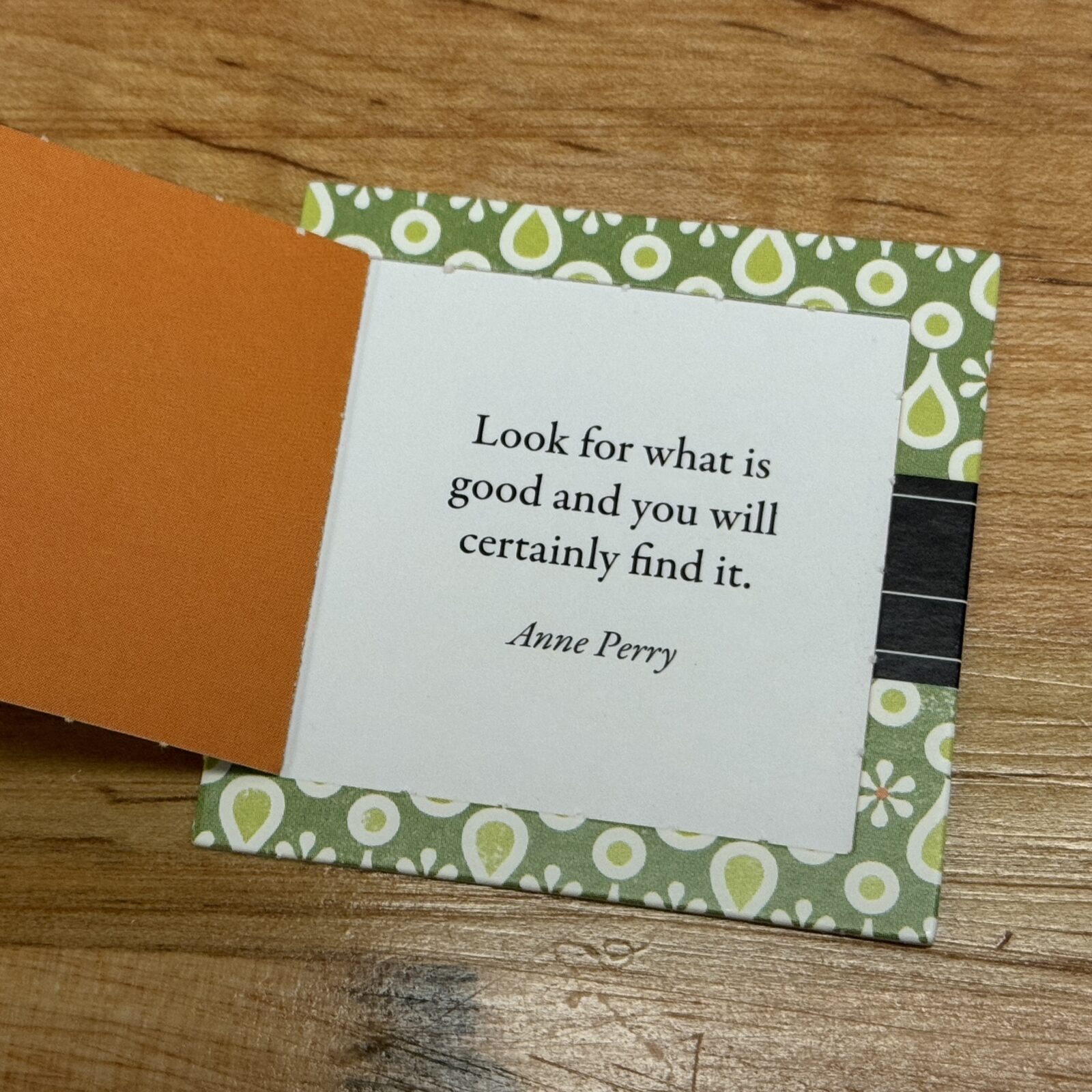
Look for what is good and you will certainly find it. – Anne Perry
I received this little note of encouragement from a new friend this week; Nicole Phillips is on a mission to spread kindness wherever she goes. We met through a mutual friend and exchanged some books and other items, and she included this message to remind me that there is good all around us if we take the time to seek it out. Nicole has a podcast and books available; check her out today!
:: Productivity and Innovation
The Prosci AI Integration Framework
One of the biggest challenges organizations face today is translating an enterprise-level AI initiative (“We are deploying generative AI tools across the organization”) to the individual level (“How AI actually fits into the day-to-day work of individuals”). This translation process is essential for successful AI adoption.
The pace of AI advancement can feel both exciting and overwhelming. For many professionals, it’s unclear how AI actually fits into their daily work. When we give people prompt libraries and copy-and-paste use cases, we’re essentially just giving them fish. The Prosci AI Integration Framework teaches them to fish—equipping them with a framework to make sense of their own personal integration of AI.
https://www.prosci.com/blog/the-prosci-ai-integration-framework
“Moral excellence comes about as a result of habit. We become just by doing just acts, temperate by doing temperate acts, brave by doing brave acts.”– Aristotle
Perfection is a disease
Ann Mukherjee is a seasoned C-Suite executive specializing in transforming global companies by leveraging demand-driven growth to drive competitive advantage. Most recently, Ann served as Chairman and CEO, Pernod Ricard NA, the second largest spirits company in the world. Prior to Pernod Ricard, Ann was Global Chief Commercial and Marketing Officer of the largest privately held CPG company, SC Johnson, overseeing businesses in over 90 countries. Ann has also served as President, PepsiCo Global Snacks, and served as CMO for Frito-Lay NA.
Ann has also served on the boards of Mondelēz, Hertz and Sabra. In 2020, President Trump appointed her to the Economic Recovery Committee during COVID, and she has also worked with President Clinton as part of the Clinton Climate Change Initiative. Ann is currently program director for the Booth School of Business at the University of Chicago, developing a new executive curriculum for next-generation CEOs.
Ann is also a friend and a big supporter of The Athena Project on Modern Leadership that Drew Ianni and I co-founded and she was our guest on Unbossing. Unbossing is a podcast with leaders on how to lead and not to boss, how to manage through a zone of influence and not just a zone of control, and why the future is a fusion of learning and unlearning.
The 40-minute episode with Ann is a masterclass on four different subjects:
- On Growing Ourselves
- On Growing Business
- On the importance of Creativity
- On Life
:: CSN’s Book of the Week
The Art of the Good Life: 52 Surprising Shortcuts to Happiness, Wealth, and Success
A simple path to happiness doesn’t exist. Rolf Dobelli, businessman and founder of the TED-style conference World Minds, has synthesized the leading thinkers and the latest science in happiness to find the best shortcuts to satisfaction in The Art of the Good Life.
The Art of the Good Life is a toolkit designed for practical living. Here you’ll find “happiness hacks”–from guilt-free shunning of technology to gleefully paying your parking tickets–that are certain to optimize your happiness. A good life isn’t guaranteed, but that doesn’t mean we can’t strive for it–and this book will give you a better chance at happiness.
:: Self-Leadership Development
The 24 New Rules for Succeeding at Work
How do you get a raise? How do you make work dinners palatable? How do you deal with an overwhelmed middle manager? We asked the people who would know.
Even as once-reliable career paths look shakier than ever, it’s still possible to find rewarding work in the office. We pelted experts with questions big and small about how to survive and even thrive—with one caveat. No platitudes about where to lean. We wanted real tactics; we wanted practical, truly executable counsel. Here’s what we got back:
“Be the first to listen and the last to speak. The wise one hears what all have to say to understand, not to be understood. The leader listens to those whom one leads.” – Laura Cobb
How to uncover your blind spots
Have you ever been caught off guard by what someone observed about you? Perhaps they described a version of you, or a particular aspect, that didn’t align with your view of yourself. Moments like these can result in a range of feelings, from anxiety and frustration to surprise and curiosity. Often, this other person has pointed out a figurative ‘blind spot’: something about you that you haven’t been able to see clearly.
Everyone has blind spots. After all, we see ourselves and our intentions from the inside out, others experience us from the outside in, and those views cannot be perfectly in sync. Of course, not everyone will perceive you the same way, or with the same clarity, so blind spots are also somewhat subjective.
https://psyche.co/guides/how-to-uncover-your-blind-spots
Inward, Outward, Forward
See what Dan Pink has to say about facing a regret you’ve been avoiding or dwelling on. They won’t just go away; you have to process them.
“If you don’t like the road you’re walking, start paving another one.” — Dolly Parton
Change These Questions
Questions are the language of leaders. Some of the most powerful questions are the ones we ask ourselves. Sadly, the wrong questions will also hold us back.
Below are five common questions Dave Stachowiak often hears leaders asking themselves that often become counterproductive. Consider shifting these questions to help you lead better. Which of these are speaking directly to YOU?
1) Am I doing too much?
Almost every leader I work with cares a lot about success. Almost all of them are ready and willing to do the work to get there. While “Am I doing enough?” can be a helpful question, more often I see leaders doing too much. Lean in on delegation and coaching to support the growth of future leaders.
2) How do I create experts?
A lot of leaders got the job they have today because they were the chief expert in their last job. That’s not usually what the current job requires. A big inflection point for many leaders is resisting the temptation to be the expert on everything. Instead, start developing expertise in others. Marshall Goldsmith’s words often ring true: “What got you here won’t get you there.”
3) How do I market my team?
A question I often hear from leaders is, “How do I market myself without seeming like I’m bragging?” A helpful starting point is to begin with your team. Rather than bragging about themselves, most leaders find it easier and more joyful to socialize the wins of their employees. This comes back to you, too: few things market a leader better than a team that’s accomplishing a lot.
4) What do I need to stop doing?
Asking yourself what to start can be helpful. It’s just that most leaders never ask the opposite question. Almost every leader is behaving in some way that’s causing friction. If you’re not sure what that is, consider asking this question to a few trusted colleagues: “What’s one thing I should stop doing?”
5) How do I meet them where they are?
Every leader experiences vastly different personalities and preferences in their work. Rather than simply wondering why people are so different/wrong, consider adapting just a bit. Match some of their style and energy in an important interaction. Once you do, you may earn some attention to invite them to consider your way of thinking.
More from Dave: https://coachingforleaders.com/
:: Work Culture & Team Development
De-escalate conflict before it explodes
It does not take much for conversations to escalate in the current climate. People are angry. And that anger is spilling into workplaces.
Conversations that once involved healthy tension and discussion are becoming emotionally charged, reactive and deeply personal – fast. A challenge to an idea becomes a challenge to someone’s values, competence or character. Feedback becomes personal criticism. A disagreement becomes a moral argument. For HR leaders and people managers, this creates a difficult environment to navigate.
“On any given day, you may struggle with your habits because you’re too busy or too tired or too overwhelmed or hundreds of other reasons. Over the long run, the real reason you fail to stick with habits is that your self-image gets in the way. This is why you can’t get too attached to one version of your identity. Progress requires unlearning. Becoming the best version of yourself requires you to continuously edit your beliefs, and to upgrade and expand your identity.” – James Clear
Care-Centered Leadership in the Age of AI
Care-Centered Leadership in the Age of AI – a DisruptHR talk by Carlee Wolfe – Associate VP, Leader Development and Organizational Effectiveness at Hyatt Hotels.
:: Servant Leadership
Servant leadership for the win, with Dan Erschen of Wisconsin Metal Parts
Dan Erschen is the owner of Wisconsin Metal Parts – a contract manufacturer of metal parts and assemblies in Waukesha, Wisconsin. A proponent of servant leadership, Dan explains why this concept has transformed his company and even his life. Dan has battled multiple sclerosis throughout his adult life, a journey that has shaped his outlook both as a business owner and as a person in general.
https://makingchips.com/servant-leadership-for-the-win-with-dan-erschen-of-wisconsin-metal-parts/
:: Upcoming Events
Coaching Community of Practice (CCoP) October Meeting
People in diverse roles across campus utilize many different forms of coaching. The Coaching Community of Practice (CCoP) is a virtual space for leaders and learners, coaches and non-coaches from across campus. We offer resources, tools, and frameworks focused on coaching skills, engage in facilitated discussions, and utilize breakout rooms for peer conversations and coaching practice. As we build our capacity as leaders and coaches, we’re also strengthening the coaching culture across campus. Use this link to join our next CCoP on October 22nd from 12 – 1:00 pm CT: go.wisc.edu/u5qd32