Planners’ Picks — October 20, 2026

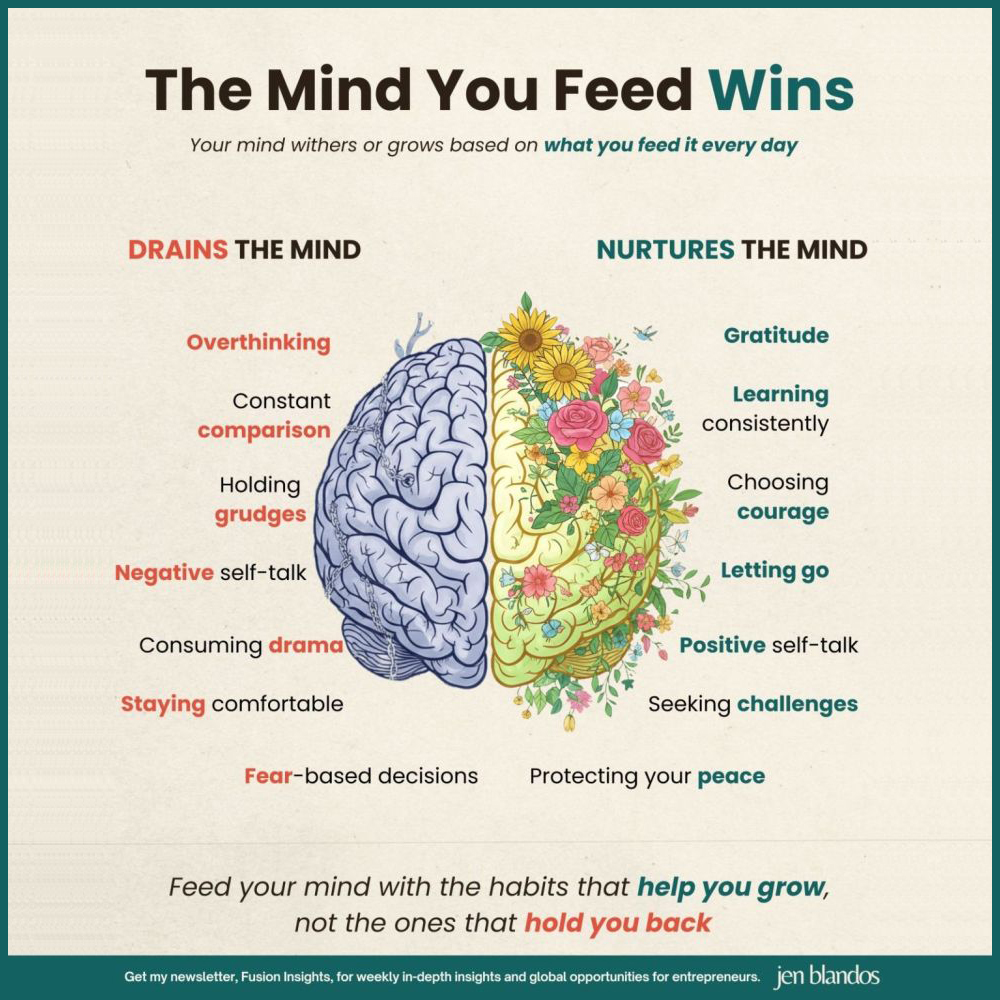
What are you feeding your mind? How do you lead through fear? Where do you want to be when this year ends? These questions and more are covered in this week’s installment of PP.
Special shout-out to one of our planners, Nancy Kujak-Ford, on landing a new position at the UW after continually showing up and leading her team with love and respect. See? This stuff really works!
One last comment: Servant leadership shows up in the most interesting places: Milwaukee Brewers manager Pat Murphy clearly understands this in the way he has built up a team of “gamers” from all levels to dominate in the 2026 season. Soon we’ll be talking about how they won the World Series. For now, enjoy this quote from A Great and Glorious Game: Baseball Writings of A. Bartlett Giamatti:
“It breaks your heart. It is designed to break your heart. The game begins in the spring, when everything else begins again, and it blossoms in the summer, filling the afternoons and evenings, and then as soon as the chill rains come, it stops and leaves you to face the fall alone.”
:: Image of the Week
“You pity the moth confusing a lamp for the moon. Yet here you are confusing a screen for the world.” -Jay Alto
:: CSN’s Book of the Week
Leadership Strategy and Tactics: Field Manual (audiobook)
The ultimate guide on leadership from the #1 New York Times bestselling co-author of Extreme Ownership.
In the military, a field manual provides instructions in simple, clear, step-by-step language to help soldiers complete their mission. In the civilian sector, books offer information on everything from fixing a leaky faucet to developing an effective workout program to cooking a good steak.
But what if you are promoted into a new position leading your former peers? What if you don’t get selected for the leadership position you wanted? How do you overcome imposter syndrome, when you aren’t sure you should be leading? As a leader, how do you judiciously dole out punishment? What about reward? How do you build trust with your both your superiors and your subordinates? How do you deliver truthful criticism up and down the chain of command in a tactful and positive way?
:: Courage
How to Build Courage: 9 Strategies to Lead Through Fear
If you’ve ever sat on a critical decision longer than you should have, delayed a strategic move for your organization because the risk felt too high, or failed to intervene when someone on your team was being sidelined or mistreated, you know how moments of leadership hesitation can haunt you. You might replay them, kicking yourself. Or you may start telling yourself a damaging story: You don’t have what it takes for bold leadership.
The truth is, fears and inaction strike in all our lives, especially in times of extraordinary change. But they don’t have to define how we respond. Harvard Business School professor Ranjay Gulati spent 12 years researching and writing his latest book, How to Be Bold: The Surprising Science of Everyday Courage, and says a simple equation explains why our courage is so frequently stymied. “I like to think of it as the ‘fear equation’: uncertainty + loss of control = fear,” he writes. “That fear in turn can prevent us from acting, even if we’re normally quite brave.”
Gulati set out to understand what personal beliefs and behaviors spur people to find courage in the face of fear. “Modern-day Hollywood movies and fiction writing project an image of these people who are congenitally courageous,” he notes. He interviewed dozens of subjects to understand the science of bold action. What he found were scores of examples of people—from Mahatma Gandhi to Simone Biles to ordinary people—who struggled to be bold at times but equipped themselves with skills and strategies to find courage in the face of fear. “I came to realize that courage is a muscle you can build,” he says.
https://www.success.com/how-to-build-courage-9-strategies-to-lead-through-fear
:: Self-Leadership Development
How high-hope leadership prepares organizations for uncertainty
Most leadership teams are still running a 2000s operating system: growth at any cost, quarter by quarter. It isn’t a strategy problem. It’s a poverty of imagination and a deficit of anticipation — and it ends the same way every time, with an organization scrambling to react to technological disruption with AI, climate risks to supply chain, staffing problems due to an aging population and more.
There’s an alternative, and it starts somewhere most executives don’t look — hope.
“Inspiration is a guest that does not willingly visit the lazy.” – Pyotr Ilyich Tchaikovsky
How Can Leaders Create the Conditions for Staff to Succeed?
In this episode of Getting Unstuck: Cultivating Curiosity, Rich discusses his leadership journey and the principles that guide his work. Drawing on more than 35 years in the printing industry, Rich explains how influential mentors shaped his belief that effective leaders provide both autonomy and support. He recalls a manager who trusted employees to make decisions while remaining available during difficult moments—a model that continues to inform his own leadership style.
Rich emphasizes that leadership is fundamentally about people. He believes employees perform best when they feel valued, understood, and connected to the larger purpose of their work. Whether by sharing customer praise, encouraging innovation, or involving staff in major decisions, such as relocating the print shop, he seeks to create an environment where people feel a sense of ownership and agency.
Podcast host Jeff Ikler also has some great insights from his long career in educational publishing. Great leadership is less about having the answers and more about creating the conditions for others to succeed. Leaders serve their teams best when they listen, build trust, remove obstacles, and help people see the significance of their contributions.
https://www.queticocoaching.com/blog/418-how-can-leaders-create-the-conditions-for-staff-to-succeed
:: Developing Better Habits
How to Build a Habit by Starting Ridiculously Small
In 75 minutes a week, I can reap the benefits of listening to uplifting music, getting out in nature, and getting morning outdoor light, all while exercising my dogs and getting enough cardio to measurably improve my health, happiness, and longevity.
Creating a habit takes energy and focus, and we’ve only got so much of either, which is why ambitious plans produce a brilliant week and then…nothing. It takes between 18 and 254 days for a behavior to become automatic, and what predicts faster adoption isn’t ambition, self-discipline, or willpower; it’s repetition.
https://greatergood.berkeley.edu/article/item/how_to_build_a_habit_by_starting_ridiculously_small
:: Productivity and Innovation
Finish Strong
There are about ten weeks left in 2026.
That’s enough time to finish strong. To close out a goal you set back in January. To land a few more clients, launch the thing you’ve been sitting on, or simply end the year feeling steady instead of frantic.
It’s also enough time to get swept up in the holidays and land in January wondering where it all went.
The difference is usually a little intentional time on the calendar now. Before the school concerts, the holiday parties, the travel, and the end-of-year everything start filling your days for you.
Here’s what I’ve learned: reflection doesn’t happen by accident. If you wait until you “have time,” you won’t. The calendar always fills itself. So you have to claim the space first.
Sometime in the next two weeks, block an hour for yourself. Put it on the calendar like a client meeting, because it matters just as much.
Go somewhere you like being. A coffee shop, a walk by the water, your favorite chair with a blanket. Bring a notebook. Leave the to-do list behind.
Then sit with three questions:
1. Where do I want to be when this year ends?
Not the whole five-year vision. Just the finish line for 2026. What would make you look back in December and think, “Yes. That was a good year”?
2. What are my priorities to get there?
Pick a few. Not everything. If everything is a priority, nothing is. What actually moves you toward that finish line?
3. What do I need to say no to, or put down, to get there?
This is the one most of us skip. It’s also the one that makes room for everything else. Maybe it’s a project that’s run its course. A commitment you said yes to out of obligation. A new idea that’s exciting but not for right now.
Putting something down isn’t quitting. It’s choosing.
You don’t need a brand-new plan. You probably need a clearer version of the one you already have.
From Emily Bissen’s weekly newsletter “The Sunday Simmer”: https://www.blueheronbusinesspartners.com/
“I have noticed that doing the sensible thing is only a good idea when the decision is quite small. For the life-changing things, you must risk it.” – Jeanette Winterson
Manage Your Time Effectively
Jenna Piché, a workplace focus researcher, discusses how to manage work hours, set boundaries, and redefine success to create a sustainable work-life balance. Learn her practical strategies to improve productivity, reduce stress, and put your energy toward what truly matters.
One of the ideas at the heart of Jenna’s work came through in this conversation:
I don’t want people to get more done. I want them to get the right things done.
https://www.youtube.com/watch?v=h2RRVe1WD5s
:: Communication
How to Connect with People Better, with Charles Duhigg
Supercommunicators aren’t always the loudest or leading the conversation, but they ask more questions and adapt better in the moment. Instead of just asking factual questions, Charles invites us to ask emotional questions.
Key action: Make emotional replies easier for others. Instead of “Do you have any hobbies?” ask, “If you could learn anything, what would it be?”
https://www.youtube.com/watch?v=m829GXaILiw
“It’s remarkable how often the real problem is not what happened, but how it was communicated.” – James Clear
Holding silence and listening – two important skills for managers
I remember it as clearly as if it was yesterday.
I was part of a leadership team, and we had gone through a turbulent time with a few major and unexpected personnel changes. There was so much friction that we weren’t working effectively together and our director wanted to turn things around.
An external facilitator joined us for a day at a venue away from the office. He asked us to talk about what had been going on and how people felt about it. The silence was palpable. Heads down. Everyone avoiding eye contact. No-one spoke. You could have heard a pin drop. It was like a game of chicken. Who was going to break first?
I’ll tell you who didn’t break first. The facilitator. He held that silence in a way that I’d never seen before. He sat there calmly, smiling gently. Making the occasional note in his book. Looking out the window at the amazing gardens. He just seemed so comfortable in that silence!
Still the silence held. I kept looking at the clock. We were at four minutes. Four interminable minutes. The ticking of the second hand on the clock was SO LOUD! Was it not driving anyone else crazy? Still no sign of anyone breaking. Another 30 seconds. And then someone broke. It was me. I was the one who broke. The conversation started and the work began.
That happened more than 20 years ago but it still stays with me. I think about his calmness in the silence almost every day.
See what Dr. Hayley Lewis continues to say about silence and listening here: https://www.linkedin.com/pulse/holding-silence-listening-two-important-skills-managers-lewis-g38le/
:: Kindness in Leadership
Kindness at Work: Leadership, Loyalty, and Legacy
Two Cindys. One shared belief: kindness belongs at work.
In this episode of The Kindness Advantage, Cindy Rowe talks with her kindness “twin,” Cindy Smarsh, workplace well-being expert and creator of The K.I.N.D.N.E.S.S. Code™.
Together, the Cindys explore what it takes to create a wellness-first workplace where people feel connected, know they belong, and believe their work matters. They also challenge the misconception that kind leadership means being soft, avoiding accountability, or hugging everyone in the hallway.
Real kindness at work can look like having an honest heart-to-heart conversation, recognizing the human behind the role, and caring enough to lead people in the way they need to be led. These behaviors strengthen trust, encourage loyalty, and influence the workplace culture future leaders will inherit.
You’ll also hear an important question every leader should consider: What do you want your leadership legacy to be?
The conversation ends with a powerful reminder from the Platinum Rule: Treat others the way they want to be treated.
:: LinkedIn Learning
How to Stay Focused When Stress Peaks with Deepak Chopra
Feeling overwhelmed or stretched thin? Want to navigate stress like a pro? In this exclusive conversation with LinkedIn career expert Andrew Seaman, join best-selling author and global leader in mental health, Deepak Chopra, MD, as he shares invaluable insights on achieving mental clarity in today’s digitally demanding world. Along the way, Deepak unveils frameworks to transform stress into opportunities, cultivate resilience, and embrace change, especially in the evolving AI landscape. Whether you’re looking for mind-calming habits or easy-to-apply practical strategies, this session will equip you with the tools you need to remain flexible and grounded under pressure. This is a recording of a live event and features audience participation and an unscripted Q&A. Visit linkedin.com/events for more can’t-miss conversations featuring prominent leaders.
“Pressure feels like a threat, but it’s not. You feel pressure when your decisions matter, and people depend on you. It can feel uncomfortable at times, but it’s also a privilege. When no one relies on you — when no one expects something from you — you’re irrelevant. Pressure is a privilege.” – Shane Parrish
:: Mental Health and Self Care
How to Know When It’s Time to Reinvent Yourself
Reinvention. It’s a word that gets thrown around a lot—especially in the season of New Year’s resolutions. But what exactly does reinvention mean? What does it look like professionally and personally? What makes it meaningful? And how do you know when the time is right to reinvent yourself?
We spoke with Pamela Mitchell, founder and chief executive officer of The Reinvention Institute and the author of The 10 Laws of Career Reinvention: Essential Survival Skills for Any Economy, to find some answers to these questions. According to Mitchell, reinvention isn’t something you do once and never again. Instead, she sees it as a skill that requires lifelong practice.
https://www.success.com/how-to-reinvent-your-career-without-starting-over
:: Upcoming Events
Introducing SEAT: UW–Madison’s Change Management Framework
Change is a constant at UW–Madison, and supervisors often play an important role in helping employees understand and navigate what is changing. Whether the change involves a new process, technology, policy, organizational structure, or way of working, how people experience and respond to change can have a significant impact on successful adoption.
Developed collaboratively with campus partners, SEAT (Stage, Engage, Act, Thrive) is UW–Madison’s practical Change Management Framework and Toolkit. In this session, participants will take a closer look at the framework, explore the tools and resources included in the toolkit, and consider how SEAT can help them think through and support the people side of change.
In this interactive session, participants will:
- Explore the four stages of the SEAT Framework and how they can be applied to different types of change.
- Discover practical tools and resources in the Change Management Toolkit that can help leaders and teams navigate the people side of change.
- Consider how SEAT can help them prepare, engage, and support employees through changes affecting their teams.
Presented by Jen Erickson of the Office of Strategic Consulting.
Jen’s Bio
Jenny Erickson has more than 20 years of experience in community, organizational, and leadership development. As Capacity Building Lead in UW–Madison’s Office of Strategic Consulting, she develops learning experiences and practical tools that help campus teams lead change, strengthen performance, and build healthy workplace cultures. Previously, Jenny served as a professor and community development educator with UW–Madison Division of Extension, partnering with organizations to identify needs, develop solutions, and evaluate impact.
Date: November 19, 2026
Time: 10:00-11:00 am
Online via Zoom Link
Understanding Your Identities and Experiences
Each of us brings a unique blend of experiences, identities, and values to the workplace—and they shape how we see the world, interact with others, and how we participate and contribute to our teams. In this course, you’ll have the opportunity to reflect on your own experiences, identities, and values and consider how they influence workplace interactions, culture, and perceptions. You will also explore how these factors can shape our assumptions and perspectives. Finally, you’ll be introduced to a practical tool designed to check for and navigate assumptions effectively.
Why should you attend:
• Explore your individual experiences, identities, and values.
• Build awareness of how identities, experiences and values shape perceptions and workplace dynamics.
• Learn how to check for assumptions.
Part of the Thrive@UW Program , open to all UW–Madison employees. Select Offerings to determine which dates are virtual and which will be held in a classroom;
Dates: November 5 (in-person), December 3 (online)