Planners’ Picks — November 17, 2026

As we enter the holiday season and near the end of the fall semester, we start seeing posts about utilizing these last 50 days to our advantage. We can do that by thinking creatively (see our book of the week), revisit our culture, focus on our own well-being, and being more curious in our conversations. All this and more in the readings and resources below!
:: Image of the Week
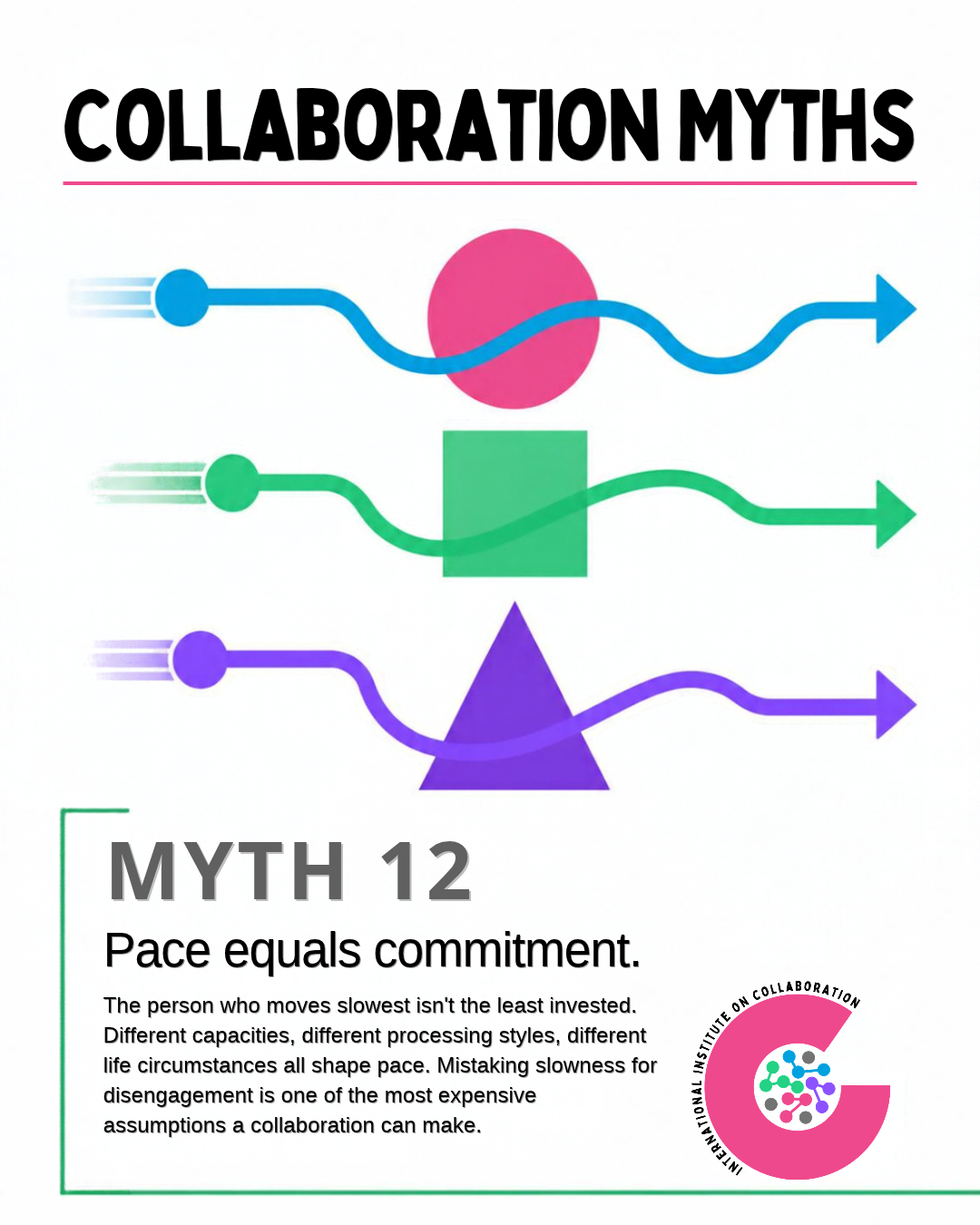
Collaboration Myths from Gregg Potter
Gregg Potter shares a weekly newsletter, “Thursday Thoughts,” and talks about CQ — Collaborative Intelligence. Last week he shared this collaboration myth that spoke to the planners; Pace doesn’t always equal commitment to a program or initiative. For more on his programs and ideas, go to https://internationalinstituteoncollaboration.com/?mc_cid=d10d63168b&mc_eid=0395b5e0dd.
:: CSN’s Book of the Week
Help Me Think Through This: Build Courage, Think Differently, and Create What’s Next
WE DON’T LACK IDEAS. We lack space and support to act on them. Between expectations, routines, and the pressure to “do it right,” creativity gets mislabeled as a talent some people have and others don’t.
Help Me Think Through This reframes creativity as a mindset of courage . . . the courage to keep going in a new and different way. Drawing on two decades of advising leaders and teams, Mary Messner shows how conformity sneaks into work and life, how self-doubt turns into stalled decisions, and why small steps beat perfect plans.
With warmth, humor, and deeply human stories, Mary walks beside the reader as a guide, a friend, and a voice in their corner. Through her framework and simple exercises, she helps them stand on their own circle, loosen the grip of comparison, and take the next brave step. For the reader who wants to speak up, lead, and act on what matters, this book offers a steady path from hesitation to action.
:: Work Culture & Team Development
Milwaukee Brewers Team Captain, Christian Yelich, Shares Magic Behind Culture
Let’s face it—culture is hard to measure, and it is the best predictor for long-term organizational success. As a leader, you cannot ignore culture. Rather, you must be nearly obsessed with culture. What makes a championship culture of trust and teamwork? In an interview with Alex Rodriguez during the World Series, Milwaukee Brewers Team Captain Christian Yelich shared his perspective on the magic behind the Brewers’ championship culture.
https://www.linkedin.com/pulse/milwaukee-brewers-team-captain-christian-yelich-shares-tjfdc
:: Creativity
Set Godin’s Hotlist (aka his 24 books on marketing, creativity, and productivity)
Seth Godin has had a presence online ever since online was in its infancy. His volume of work is impressive, spanning the range of marketing, creativity, community, and more. Check out this landing page from him on all of his printed books, with links to details on them.
“Being aware of your fear is smart. Overcoming it is the mark of a successful person.” – Seth Godin
:: Diversity and Inclusion
Why success and mattering are not the same
Robert McNamara had the figures that said the US was winning. As secretary of defense during the Vietnam War, McNamara rebuilt military decision-making around metrics: body counts, munitions spent, supply lines secured. Each dashboard was pointing in the same direction.
In a recent discussion on my podcast “Passion Struck,” author Mark Manson highlighted McNamara as a cautionary tale for anyone who relies solely on statistics. Manson told me, “The things you can’t measure ended up being far more important in the Vietnam War than the things you could measure,” referring to the North Vietnamese army’s will to continue fighting in spite of defeats. “We all have a bias toward things we can see, count and measure,” he said, and that bias convinces us those things must matter most.
Swap “war” for “org chart” and the warning holds. Because of their visibility and comparability, leaders monitor revenue, retention rates and performance evaluations. What they routinely miss is a subtler question with far more predictive power over whether someone stays, contributes and thrives: Does this person feel like they matter?
Success and mattering aren’t the same, and confusing them is one of the most expensive mistakes a leader can make.
See four ways leaders can do things differently to ensure people know they matter.
:: Managing Up
Get Your Coworkers to Embrace Your Great Idea and Make a Bigger Impact
Today on Asking for a Friend: Worth Another Conversation edition, Karin answers a question we hear often in our Courageous Cultures leadership programs: How do I get MY COWORKERS to buy into my idea?
“I went to my boss with a great idea, and she said, “Go see what your coworkers think.” They’re already so busy and overwhelmed, I’m finding it hard to get their attention. What should I do?” How do I convince my coworkers I have a great idea?
Your great idea could make work (and life) better for everyone and could have a real impact on the results of the organization. And, your boss is far more likely to embrace your new idea when everyone else is talking about the benefits too. With more people in support, your idea will be easier to implement.
Quite notably, participants in our strategic leadership and team innovation programs said that when they shared their great ideas and spoke up courageously at work they felt “excited,” “proud,” and “accomplished.”
If you’re ready to help your organization bust through the notion of “that’s the way we’ve always done it” and share your ideas so you can innovate for progress and results, start here.
“People think focus means saying YES to the thing you’ve got to focus on. But that’s not what it means at all. It means saying NO to the hundred other good ideas that there are.” – Steve Jobs
:: LinkedIn Learning
Well-Being as a Habit: Tips and Best Practices
Explore the transformative power of well-being in the workplace by learning to shift from reactive habits to intentional high-value output. This course covers how to leverage a well-being performance model, designing a sustainable performance system, and conducting a 30-day habit experiment. Discover why willpower often fails and explore strategies like setting boundaries and creating flow environments to boost well-being. Learn how to diagnose friction points like chronic overload and apply practical solutions using the Filter, Gate, and Reset model. Design habits that fit within your role and capacity while protecting against burnout. This course also offers practical tools for improving decision-making and boosting performance. Benefit by learning how to evaluate trade-offs between short-term responsiveness and long-term sustainable performance. By the end of this course, you’ll be more equipped to implement energy-protecting habits that enhance both personal and team well-being.
:: Communication
How to Give Feedback: Start With a Two-Minute Conversation
This is from Kim Scott, author of Radical Candor:
When I worked at Google, my boss asked me to walk back to her office with me after an important meeting. The two minutes we spent together were more impactful than any performance review.
You may not think you have enough time to give feedback—it’s the most common question we get at our Radical Candor workshops. I promise you: the best feedback I’ve ever gotten in my career has always happened in impromptu two-minute conversations.
THE IDEA
Feedback is like brushing your teeth, not a root canal
The best time to give feedback is in impromptu two-minute conversations, right when you notice the good or bad thing. Praise tells people what to do more of; criticism tells them what to do less of. Why wait? Continual alignment on what’s off and what’s working is what keeps everything moving smoothly.
PUT IT INTO PRACTICE
Keep slack time in your calendar or be willing to be late. Prioritizing something generally means making time for it on your calendar. But how do you make time in your calendar for something that is “impromptu”? You can’t. Better to talk to the person right away. But for that to happen, you must do one of two things. One, keep slack time in your calendar, either by not scheduling back- to- back meetings or by having twenty-five and fifty-minute meetings with hard stops, not thirty- and sixty- minute meetings.
Or, simply be willing to be late to your next meeting. Think of feedback as relationship hygiene. That’s more important than perfect punctuality. See more on this below!
“If you are not willing to learn, no one can help you. If you are determined to learn, no one can stop you.” – Zig Ziglar
The I’m Listening Podcast: Feeling Heard
This relisten episode focuses on the importance of feeling heard, how to go about it, and what happens when we don’t feel heard. We also discuss the Feeling Heard Scale and why it is important.
We all want to feel heard. When it happens, it feels good, solves problems, and productivity increases. However, when we don’t, we feel angry, walk away, or even riot. In this episode, we dive into a 2023 study about feeling heard, the different components, and how we use this information to get better at it.
Welcome to the Feeling Heard Scale (FHS). This is not about disagreement; that’s ok (generally speaking). This is about respect, understanding, and validation. Oh, and the goal is… reaching common ground.
https://www.youtube.com/watch?v=CfRb5qWY8n0
:: Mental Health and Self Care
Burnout Recovery — Sending Self Compassion
If you’ve been feeling a bit drained or short on patience, you’re not alone. Burnout is what happens when we give more than we’re able to replenish, for longer than we’re meant to.
The encouraging part is that recovery is possible, and it doesn’t require a total life overhaul. It starts with small, steady shifts: noticing what’s depleting you, finding moments of real rest, and building the inner skills that help you bounce back. This month, our theme is burnout recovery, and everything below is designed to help you start feeling replenished, a few minutes at a time.
Check out this 5-minute practice from Humin!
When we’re burned out, we’re often hardest on ourselves, replaying what we didn’t get done and worrying about what’s still ahead. This practice offers a different way forward. Using the breath as an anchor, you’ll send compassion to yourself across time: to who you were, who you are right now, and who you’re becoming. It’s a gentle reminder that recovery begins with how we treat ourselves.
The link below takes you to the download page for the Healthy Minds app, and once it’s open you’ll be taken to the meditation program.
:: Curiosity
Curiosity is the Antidote to Contraction
It’s easy to forget that we are biological beings.
And it’s always good to remember: we’re not gods, just incredibly developed apes who have created for themselves powers and technology that look godlike.
And sometimes our biological nature is right in our face: in sickness, when our hormones shift perceptably, when we have to go to the bathroom, when arousal takes over.
Or, indeed, when we see red.
When something trips our system and we find ourselves far, far away from the rational, computer-like being we pretend to be.
It’s easy to see with a toddler, because it’s all over their face. They switch into the red and out of the red at a moment’s notice (or, at least, mine do).
Adults are different. We’ve all learned to become masters of disguise, hiding what’s going on inside us with incredibly skill so that our friend can be signed off work with severe anxiety and we didn’t even notice.
So you can’t always see when someone else is tripped. That’s why codewords and ground rules can help. The Conscious Leadership Group and Brené Brown use the shorthand: am I above or below the line?
https://www.linkedin.com/pulse/curiosity-antidote-contraction-robbie-swale-bst7e
I just never, ever want to give up. Most battles are won in the 11th hour, and most people give up. If you give up once, it’s quite hard. If you give up a second time, it’s a little bit easier. Give up a third time, it’s starting to become a habit. – Lewis Gordon Pugh
:: Self-Leadership Development
Culture Starts Here: Leaders Need to Be Led
The higher you go in leadership, the harder it can be to get an honest perspective. And when you’re leading through transition, growth, or culture change, going it alone can limit what you’re able to see.
In this podcast, CEO Heather Haas and leadership consultant BJ McKay are joined by John D’Addario III, CEO of D’Addario, for a conversation about leadership transition, culture clarity, and the value of outside perspective.
What does it take to honor a company’s legacy while leading it into the future? Heather and BJ talk with John about stepping into the CEO role after a founder-led era, revisiting values, and partnering with ADVISA to build alignment across the organization.
:: Upcoming Events
Promoting Resilience in You and Your Team
Presented by IT Leadership Development in partnership with the Campus Supervisors Network
Join Rich Gassen (Campus Supervisors Network) and Theresa Kim (Learning and Talent Development) for “Promoting Resilience in You and Your Team.” Using LTD resources and content from Heather Younger’s The Art of Caring Leadership, the session will explore practical strategies for building personal resilience and fostering it across your team. You do not need to be associated with the IT Leadership Development group to attend this event.
Date: November 18, 2026
Time: 3:00-4:00 pm CST
No registration needed; log into the Zoom meeting at the time of event: https://uwmadison.zoom.us/j/97025575880
Introducing SEAT: UW–Madison’s Change Management Framework
Change is a constant at UW–Madison, and supervisors often play an important role in helping employees understand and navigate what is changing. Whether the change involves a new process, technology, policy, organizational structure, or way of working, how people experience and respond to change can have a significant impact on successful adoption.
Developed collaboratively with campus partners, SEAT (Stage, Engage, Act, Thrive) is UW–Madison’s practical Change Management Framework and Toolkit. In this session, participants will take a closer look at the framework, explore the tools and resources included in the toolkit, and consider how SEAT can help them think through and support the people side of change.
In this interactive session, participants will:
- Explore the four stages of the SEAT Framework and how they can be applied to different types of change.
- Discover practical tools and resources in the Change Management Toolkit that can help leaders and teams navigate the people side of change.
- Consider how SEAT can help them prepare, engage, and support employees through changes affecting their teams.
Presented by Jen Erickson of the Office of Strategic Consulting.
Date: November 19, 2026
Time: 10:00-11:00 am
Online via Zoom Link